
- All
- Product Name
- Product Keyword
- Product Model
- Product Summary
- Product Description
- Multi Field Search
Views: 0 Author: Site Editor Publish Time: 2026-10-26 Origin: Site


Expanding EV charging infrastructure frequently forces facility managers into a costly bottleneck. You often face severe restrictions from your existing electrical panels. Your site transformer might lack the raw capacity for a massive fleet. Upgrading this utility infrastructure demands massive capital expenditure. It also introduces crippling deployment delays. Load management software completely bypasses these physical grid limitations. However, buyers face a critical choice. You must weigh the rock-solid reliability of static limits against dynamic scalability. This central decision dictates your upfront deployment costs. It also determines your long-term fleet expansion capabilities. Choosing correctly requires deep technical understanding. You need to know how a charging station handles power restrictions. We will examine these limits at both the hardware and software levels. You will learn actionable strategies to prevent tripped breakers and scale efficiently.
Static load management is a cost-effective, hard-coded solution ideal for small-scale deployments with predictable dwell times, but it artificially limits total charging capacity.
Dynamic Load Management (DLM) reads the building's or panel's real-time energy consumption, automatically allocating surplus power to chargers and safely throttling down during peak facility demand.
Hardware selection matters: executing DLM effectively requires a compliant smart AC charger with reliable offline fallback limits to prevent tripped breakers during network outages.
Before selecting a management type, a baseline commercial EV charger site assessment is required to map actual facility load profiles against projected EV energy demands.
Grid limits represent strict physical boundaries. Most commercial panels offer standard 200A or 400A service. They leave remarkably little room for heavy EV loads. Adding just four high-speed chargers can consume 160A instantly. Upgrading transformers costs tens of thousands of dollars. You also face months of municipal utility delays. Trenching new conduit disrupts your daily facility operations heavily.
You must define project success clearly. The ultimate goal is maximizing your active charging ports safely. You must obey the National Electrical Code (NEC). It mandates keeping continuous electrical loads below an 80% safety threshold. You cannot simply attach chargers until the breaker trips. Every installation requires calculated safety margins.
You need hard data before purchasing any hardware. A professional commercial EV charger site assessment provides this critical foundation. Installers analyze your 15-minute interval data over a 30-day period. This reveals the "valley" in your building’s daily load profile. EV charging safely fills these low-demand periods. You capture maximum charging value without triggering peak demand charges.
Static load management operates on rigid rules. Amperage limits are hard-coded during initial commissioning. You lock them into the chargers or local distribution circuits. For example, installers can divide a single 40A circuit permanently. It provides two fixed 20A limits. The chargers never exceed this boundary under any circumstance.
This approach offers strong implementation advantages. Setup complexity remains exceptionally low. The system acts reliably every single day. You eliminate any reliance on internet connectivity. The chargers do not need external cloud instructions to remain safe. You also avoid recurring software subscription fees.
However, you face severe capacity utilization risks. Static limits waste available power frequently. Imagine Charger A connects to a fully charged vehicle. Charger B remains artificially capped at 20A. The unused power sits idle. You cannot redirect it to the vehicle demanding faster speeds.
We recommend static management for highly specific environments. Small multi-family residential buildings work perfectly. Workplaces offering two to four ports also qualify. Vehicles usually stay parked for eight hours or more in these settings. Raw charging speed is rarely mission-critical for these daily commuters.
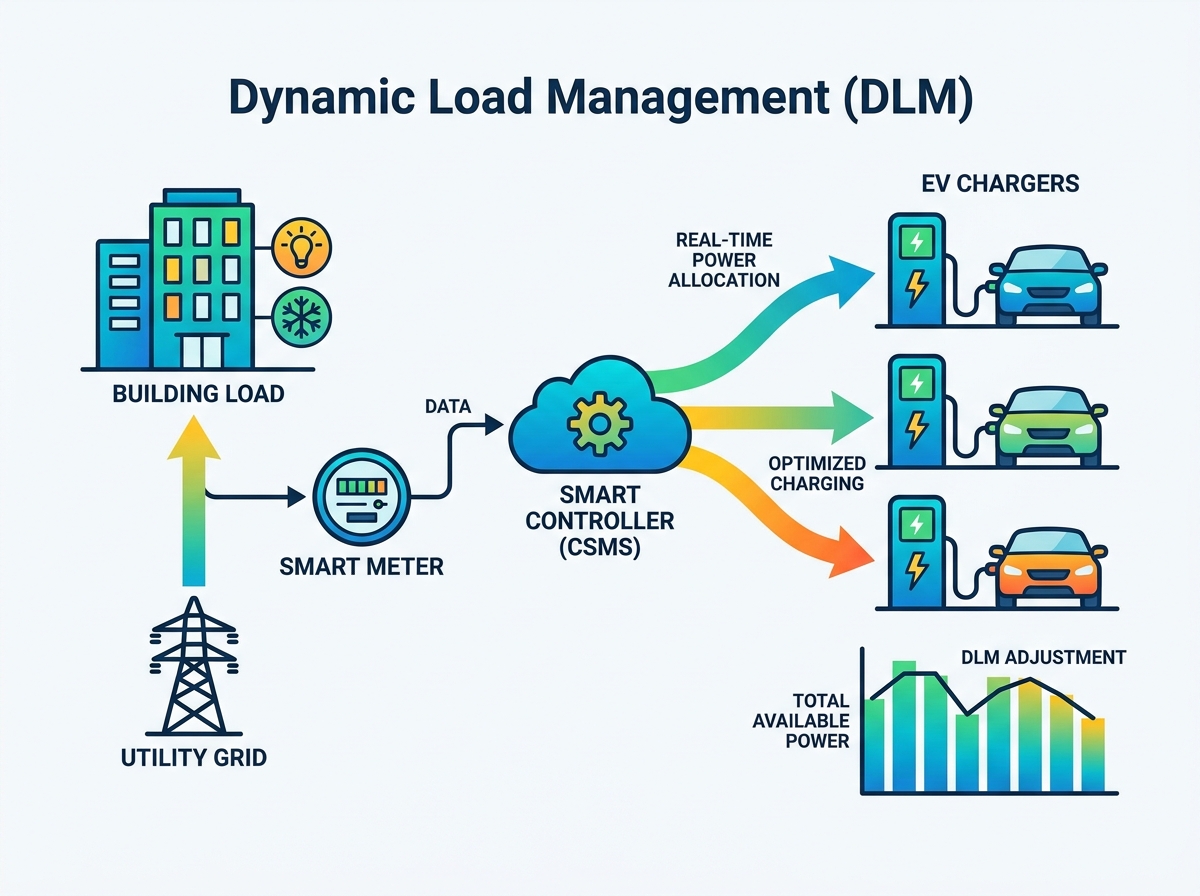
Dynamic Load Management monitors real-time power draw constantly. The system uses external CT (Current Transformer) clamps or smart meters. It tracks your facility’s total live electricity consumption. Building power usage naturally drops during off-peak hours. EV charging limits dynamically rise to fill this newly available gap.
Edge hardware plays a central role in this process. A compliant smart AC charger communicates directly via OCPP (Open Charge Point Protocol). It receives real-time power profiles from a central management system. The hardware then executes these throttling commands instantly. This ensures continuous safety across the entire site.
The financial benefits are substantial. You can safely oversubscribe your electrical panels. You might install ten chargers on a circuit designed for four. The software prevents them from drawing maximum power simultaneously. This maximizes your return on existing electrical investments.
However, dynamic systems introduce specific adoption risks. They require continuous network connectivity to function properly. You must pay ongoing software subscription costs. Installers must also perform precise calibration during deployment. A misconfigured smart meter can accidentally trigger a main facility blackout.
Feature | Static Load Management | Dynamic Load Management (DLM) |
|---|---|---|
Complexity | Low (Hardware-based limits) | High (Software and CT clamp integration) |
Network Dependency | None (Functions completely offline) | High (Requires continuous cloud connection) |
Panel Oversubscription | Not possible | Fully supported and optimized |
Recurring Fees | Generally none | Monthly or annual SaaS subscription |
Ideal Use Case | Small multi-family, predictable dwell times | Commercial fleets, large public charging hubs |
Software algorithms evaluate power division during peak demand. What happens when vehicle energy demand exceeds available supply? You must choose the right distribution logic for your facility.
Equal distribution splits available amperage evenly. All active sessions get the exact same power allocation. However, this carries a significant operational risk. Imagine too many vehicles plug in simultaneously. Charge rates drop to an unusable trickle. Cars might only receive 6A each. Some EVs will completely refuse to charge at speeds this low.
Rotational or prioritized algorithms act selectively. The system charges the first plugged-in vehicles at maximum power. It intentionally delays power to newer arrivals. It waits until the first batch is completely full. Then it rotates the available capacity to the next vehicles in queue. This First-In-First-Out (FIFO) method guarantees completed charges.
Buyers must align algorithms carefully. You need to match your operational SLAs (Service Level Agreements). Commercial delivery fleets generally require strict prioritization logic. Their vans must reach full battery by morning dispatch. Employee parking usually tolerates slower equal distribution smoothly.
Avoid vendor lock-in aggressively. You should always decouple your hardware and software platforms. Ensure your units support open protocols like OCPP 1.6J or OCPP 2.0.1. This flexibility allows switching management software providers later. You never want proprietary hardware holding your site hostage.
Network resilience requires careful evaluation. You must ask a crucial question early in procurement. What happens if your local network fails? The hardware must default to a predefined safe limit automatically. This static fallback prevents catastrophic panel overloads. It protects your facility during severe internet outages.
Security and compliance remain non-negotiable. Always demand strict UL certification for your charging equipment. Use secure data transmission protocols like TLS for all cloud communications. Verify local utility requirements thoroughly. Your system might need to support specialized demand response programs. Some utilities offer lucrative rebates for participating in grid-balancing events.
Test offline fallback behaviors during the commissioning phase.
Ensure cellular routers have backup SIM cards on diverse carrier networks.
Document the exact amperage limits assigned during offline mode.
Monitor station ping rates to detect network degradation early.
You must follow a structured approach to deploy load management safely. Rushing into hardware purchases causes severe cost overruns.
Start by quantifying your peak building load accurately. Find your available excess electrical capacity. Execute the commercial EV charger site assessment immediately. A proper assessment maps out your physical limitations. It provides the exact interval data utility companies demand for permits.
You must model the true financial impact of your choices. Static systems offer exceptionally low software expenses. However, they demand high infrastructure capital if you decide to upgrade panels later. Dynamic systems introduce ongoing SaaS fees. Fortunately, they drastically lower initial infrastructure capital. Build a comprehensive long-term budgeting model to compare these paths fairly. Project your software licensing costs across a five-year lifecycle.
Enterprise fleets should always start small. Run a limited four-port pilot deployment first. Test the software latency rigorously under real-world conditions. Verify how reliably the dynamic system throttles power during peak facility loads. Ensure your drivers understand the shifting charge rates. This pilot prevents massive failures during a full-scale fleet rollout.
Static setups offer safe, localized control for basic needs. They fit perfectly into small-scale deployments prioritizing simplicity. Commercial facilities and growing fleets need vastly different solutions. Dynamic load management remains the best financial path to scale operations safely. It maximizes your existing grid capacity seamlessly.
Infrastructure limits do not have to halt your charging network expansion.
Static limits guarantee offline safety but heavily sacrifice total charging capacity.
Dynamic scaling offers maximum hardware utilization for ambitious enterprise fleets.
Open hardware protocols dictate your long-term software flexibility and vendor independence.
Do not purchase physical hardware before defining your management software strategy. Initiate a formal energy survey to discover your actual power deficits immediately. Secure internal alignment on your operational priorities before publishing any procurement RFP.
A: Yes, provided you install a networked smart AC charger capable of receiving dynamic profiles via OCPP. Non-networked "dumb" chargers cannot be upgraded. You must ensure the initial hardware supports remote software updates and cloud connectivity.
A: Typically, yes. It relies on a cloud-based CSMS (Charging Station Management System). This software calculates and distributes power limits in real-time. It incurs ongoing SaaS costs. Some localized offline setups exist, but they are significantly harder to scale.
A: Enterprise-grade systems utilize an offline fallback feature. If the chargers lose connection to the cloud, they act automatically. They revert to a conservative, pre-programmed static limit. This safety measure ensures the main breaker does not trip.
A: Yes. Panel size only indicates maximum theoretical capacity. An assessment monitors your actual interval data over 30 days. It proves your exact available capacity. Most municipalities require this hard data for permitting load-managed systems.


