
- All
- Product Name
- Product Keyword
- Product Model
- Product Summary
- Product Description
- Multi Field Search
Views: 0 Author: Site Editor Publish Time: 2026-10-12 Origin: Site


Installing commercial EV infrastructure often hits a hard ceiling. Planners face grid capacity constraints and strict switchgear limits. Trenching for multiple standalone stations is incredibly expensive. You might not want to invest heavily in major utility upgrades. Instead, site hosts and fleet operators frequently evaluate dual-outlet architectures. These efficient layouts maximize your existing electrical capacity. Understanding this technology is absolutely critical for long-term success. You need to know exactly how a dual-outlet DC charger dynamically routes kilowatts between two vehicles. This specific knowledge guides accurate site planning. It helps operators predict actual charge times effectively. You can also accurately calculate the return on investment for your chosen DC charging equipment. Below, we break down internal power modules. We explore load balancing scenarios. Finally, we cover compliance blind spots you must avoid.
Dynamic Over Static: Modern dual-outlet DC chargers prioritize Dynamic Power Sharing (DPS), allocating kilowatts based on each vehicle’s real-time State of Charge (SoC) rather than a rigid 50/50 split.
Hardware Efficiency: Operating two dispensers from a single power cabinet significantly reduces installation costs, trenching, and grid connection fees.
BMS Communication: Intelligent power routing relies on continuous data handshakes between the charger and the vehicles’ Battery Management Systems (BMS).
Evaluating ROI: The true value of a dual-outlet system is measured by site utilization rates and avoidance of utility peak-demand charges, not just peak kilowatt output.
Deploying single-port chargers requires dedicated circuits for every parking stall. This traditional approach leads to rapidly escalating infrastructure costs. You must pay for thicker wire gauge, larger conduit, and massive breaker panels. Site hosts often discover their current transformer cannot handle the requested load. A site with ten parking stalls would need ten independent high-voltage runs. This design simply does not scale well in older facilities. Utility upgrades can delay projects by several months.
Dual-outlet systems solve this directly. They leverage a single high-capacity circuit alongside a centralized power module cabinet. This clever architecture serves two adjacent parking bays simultaneously. You only trench once. You only pull one main power feed. This reduces your upfront capital expenditure significantly. The centralized cabinet then acts as a smart dispatcher. It routes energy precisely where vehicles need it.
How do we measure a successful deployment? We evaluate a few critical success criteria:
Lower CapEx Per Port: Sharing infrastructure drops the physical installation cost per charging bay.
Maximum Hardware Utilization: A dual-port system reduces charger idle time. If one bay is empty, the other bay can use the full hardware capacity.
Utility Demand Management: Smart routing avoids triggering costly utility peak-demand thresholds. It keeps the total facility draw below penalty levels.
Hardware designers use two primary methods to distribute electricity. Older designs rely on static rules. Modern systems use dynamic routing matrices. You must understand the difference before buying any hardware.
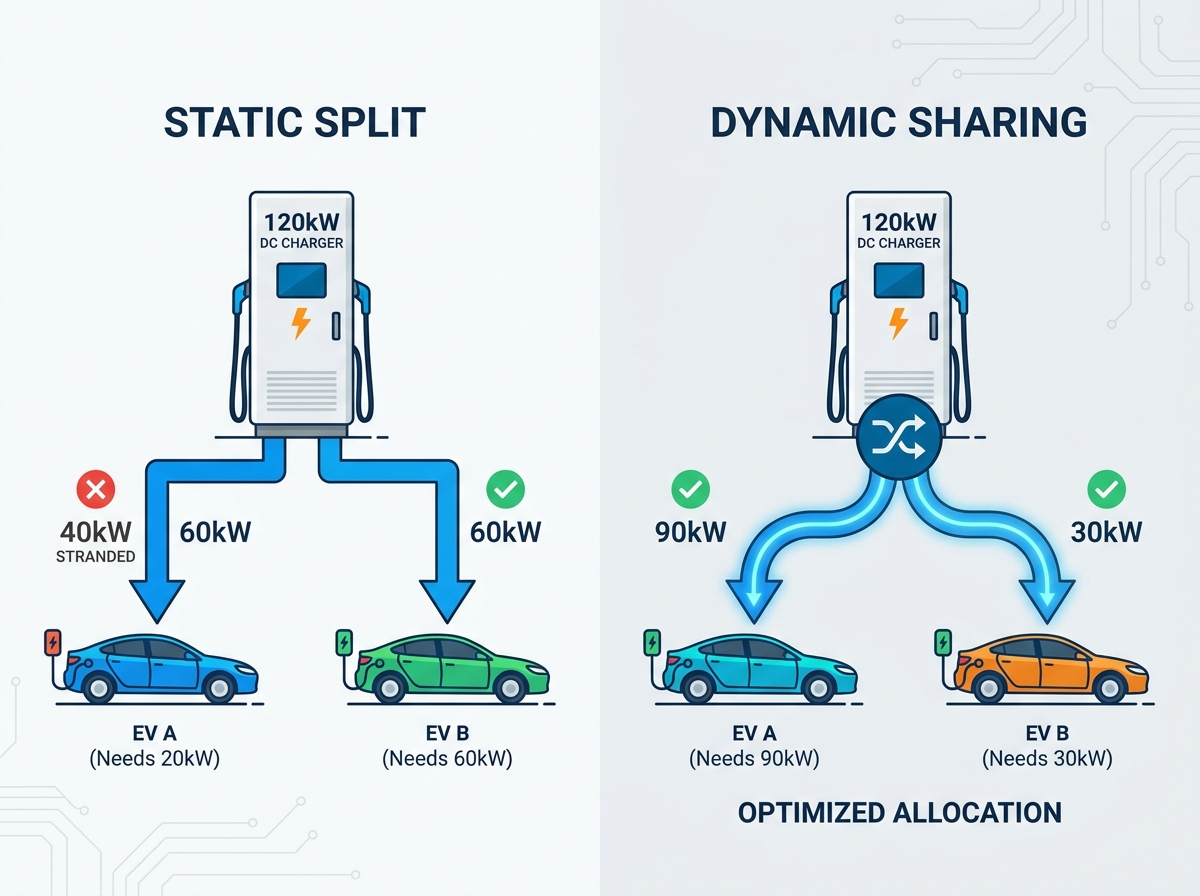
A static split acts as a hard mathematical division. It permanently halves the total output when two EVs connect. Imagine you own a 120kW charger. When two vehicles plug in, the internal relays lock exactly 60kW to each port. This mechanism requires simpler internal components. You mostly find it in older models or budget-tier equipment.
The main drawback is severe inefficiency. Suppose Vehicle A arrives with a nearly full battery. It might only accept 20kW. The static system still reserves 60kW for that port. The remaining 40kW on Port A becomes stranded. Vehicle B might desperately need 100kW, but it remains locked at its 60kW limit. You waste precious time and valuable site capacity.
Dynamic Power Sharing solves the stranded capacity problem. It uses advanced matrix routing. Inside the cabinet, engineers group smaller power modules together. Internal contactors dynamically switch these modules to active ports based on real-time demand. The charger constantly evaluates what each vehicle actually needs.
The advantage is tremendous efficiency. Let us revisit the 120kW example. Vehicle A connects and needs 90kW. Vehicle B connects and needs 30kW. The dynamic matrix routes the exact required power to each plug. Zero capacity sits idle. This improves the customer experience. Drivers spend less time waiting in your parking lot.
Table 1: Comparison of Core Power Sharing Architectures
Feature | Static Power Split | Dynamic Power Sharing (DPS) |
|---|---|---|
Allocation Method | Rigid 50/50 division | Real-time demand-based routing |
Stranded Capacity | High (wastes unused kilowatts) | Zero (all available power utilized) |
Hardware Complexity | Low (simple relays) | High (matrix contactors & software) |
Ideal Use Case | Uniform fleets charging overnight | Public stations with varied vehicles |
Understanding the internal mechanics helps planners optimize site layouts. A dual-outlet DC charger relies on high-speed data exchanges. It does not guess. It responds to strict vehicle commands.
Here is how the dynamic sharing sequence unfolds:
The Initial Handshake: An EV connects to the cable. The charger instantly establishes communication with the vehicle's Battery Management System (BMS). It determines the maximum acceptable charge rate and the current State of Charge (SoC).
Monitoring the Charge Curve Reality: Batteries do not charge at a flat rate. As a battery fills past 80%, its charge acceptance rate drops sharply. This protects the battery cells from heat damage. The charger actively monitors this deceleration.
Real-Time Reallocation: The system reacts to dropping demand. Imagine Vehicle A reaches 80% SoC and throttles down to 25kW. Vehicle B then plugs in at 10% SoC. Vehicle B demands maximum power. The charger’s internal contactors instantly reroute the freed-up power modules from Port A to Port B. They do this without interrupting either active session.
First-In, First-Out (FIFO) Prioritization: Some operators prefer rule-based hierarchy. Modern firmware allows site hosts to prioritize the vehicle arriving first. This ensures Vehicle A hits its target SoC quickly. Only then does the system divert heavy power to the second vehicle.
Table 2: Minute-by-Minute Power Reallocation Scenario (150kW Total Capacity)
Time | Vehicle A (SoC) | Vehicle A Power | Vehicle B (SoC) | Vehicle B Power |
|---|---|---|---|---|
0:00 | 20% | 150kW (Max) | Not Connected | 0kW |
0:15 | 50% | 120kW | 10% (Just Plugged In) | 30kW (Remaining) |
0:30 | 80% | 40kW (Throttled) | 30% | 110kW (Reallocated) |
0:45 | 100% (Finished) | 0kW | 60% | 150kW (Full Access) |
Choosing the right hardware requires careful inspection. Not all fast chargers perform equally well under pressure. When evaluating your next DC charging equipment, pay close attention to internal engineering choices.
Look for units packed with smaller, modular power blocks. Some manufacturers use 15kW or 30kW modules. Smaller modules allow for highly precise power slicing. If a charger uses massive 60kW modules, it cannot share power efficiently. It can only hand off energy in 60kW chunks. Smaller granularity gives the matrix routing system more flexibility.
Sustained high-output sharing generates incredible amounts of heat. Active cooling is non-negotiable for busy sites. Evaluate liquid-cooled cables versus standard air-cooled cables carefully. Liquid cooling permits thinner, lighter cables. This greatly improves user accessibility. Base your cooling choice on your intended utilization rate and specific regional climate.
Standardization is currently shifting across the industry. Ensure your unit supports the necessary physical standards for your users. Many fleet operators still require Dual CCS layouts. However, public networks frequently request a NACS/CCS combination. Selecting interchangeable connector cables future-proofs your expensive hardware investment.
Software lock-in destroys operational flexibility. Verify the hardware runs on Open Charge Point Protocol (OCPP) 1.6J or 2.0.1. This vital standard ensures you can use third-party backend software. You can seamlessly monitor sessions and tweak power-sharing parameters. You never remain stuck with the original manufacturer's proprietary network.
Even the best hardware struggles if improperly installed. Site planners frequently overlook local codes and physical constraints. You must avoid these common compliance blind spots.
Electricians must follow the National Electrical Code (NEC). Under the NEC, EV chargers qualify as "continuous loads." This classification carries a strict penalty. A dual-outlet charger requires the upstream circuit breaker to be sized at 125% of the unit's maximum combined nameplate rating. It does not matter how intelligently it shares power internally. A 120kW unit drawing roughly 150 amps requires a breaker sized for at least 187.5 amps. Do not ignore this rule during initial site planning.
Managing two heavy DC cables from a single pedestal creates physical challenges. Cables frequently drop to the ground. This introduces serious trip hazards between adjacent parking bays. Heavy connector heads break easily when dropped on concrete. You must require robust cable retraction systems. Reliable retractors pull cables up and out of the way, keeping your site safe and ADA-compliant.
Dynamic sharing remains entirely software-reliant. The internal matrix needs constant instructions. Network outages or internal firmware bugs can disrupt this logic. When software fails, many units automatically fallback to a static 50/50 split to remain safe. Some may even severely limit total output. Always evaluate the manufacturer's Service Level Agreement (SLA). Demand high uptime guarantees and rapid remote troubleshooting capabilities.
Dual-outlet DC charging equipment effectively transforms stranded electrical capacity into highly utilized assets. By smartly routing power exactly where it is needed most, you stretch your infrastructure dollars further. This approach prevents expensive, time-consuming utility upgrades.
Your decision logic should remain straightforward. Choose static splits only for highly predictable, uniform overnight fleets. For high-turnover public charging or mixed vehicle fleets, dynamic power sharing is completely mandatory to justify the capital expense.
Your next step requires action. Conduct a comprehensive site energy audit. Determine your exact peak available kilowatt capacity. Once you know your hard electrical limits, you can confidently shortlist hardware vendors and design a resilient layout.
A: No. The maximum advertised speed (e.g., 180kW) represents the total capacity of the main power cabinet. If two cars charge simultaneously, that 180kW is divided between them based on the system's internal power-sharing rules.
A: In a dynamic power-sharing setup, things change instantly. Once the first EV finishes charging, its BMS stops requesting power. The charger then instantly routes 100% of the available capacity to the second connected EV.
A: Not necessarily. A 120kW dual-outlet charger requires the exact same electrical service and breaker size as a 120kW single-outlet charger. The key difference is the dual unit cleverly splits that existing capacity across two distinct parking spaces.
A: No. The charger strictly follows the specific power requests dictated by the vehicle's own Battery Management System. Power sharing simply limits the maximum available supply. It never forces more power than the vehicle can safely accept.


