
- All
- Product Name
- Product Keyword
- Product Model
- Product Summary
- Product Description
- Multi Field Search
Views: 0 Author: Site Editor Publish Time: 2026-06-30 Origin: Site


You can see the world change as ev charging networks grow quickly. Now, there are more charging stations than petrol pumps in the U.K. By April 2026, there will be over 120,000 public chargers. More people are picking electric cars, so ev charging is getting bigger. These top companies bring new ideas, care for the planet, and make charging smarter for all.
Region | Market Share | Projected CAGR | Key Drivers |
|---|---|---|---|
Europe | Second-largest | 12.67% | Carbon neutrality goals, EV help from the government, rules about emissions, money for charging corridors |
Asia Pacific | Dominant | 21% | China’s EV use is over half of new car sales, so there is a big need for charging services |
The global EV charging market will be worth USD 65.7 billion by 2026. This is because more people want electric vehicles. Charging networks are also getting bigger.
Government incentives are very important for EV charging growth. They help make electric vehicles cheaper. They also help build more charging stations.
Top companies like Tesla, ChargePoint, and Shell are making new ideas. They use ultra-fast charging, smart platforms, and green practices. These things make EV charging better.
People are switching to electric vehicles quickly. The global market for charging stations will reach USD 65.7 billion in 2026. Many want easy ways to charge their cars, so charging networks are growing everywhere. Public charging spots are now found in cities and on highways. Ultra-rapid charging lets you fill your battery in just a few minutes. You can find charging stations at malls, parking lots, and even at home.
Here are the regions leading in charging:
Asia Pacific: This region grows fastest. Countries like China, Japan, South Korea, and India want more electric vehicles. They give government incentives to help.
Europe: There is a strong push for carbon neutrality. Germany, the U.K., and France spend money on charging networks and public charging.
North America: The U.S. leads with federal funding and more fast-charging stations. Charging electric vehicles is becoming normal every day.
You may ask why ev charging companies do so well. Government incentives are very important. Charging is now seen as basic infrastructure, not just something extra. Policies help long-term growth and care for the planet.
Government incentives and rules are key for the EV charging industry. They give money and set up laws. Tax credits and subsidies help build more charging stations. Rules make sure charging is part of city plans.
Here’s a quick look at how incentives help:
Incentive Type | Impact on EV Market |
|---|---|
Tax Credits | Makes EVs cheaper, so more people buy them |
Grants/Subsidies | Helps businesses build more charging stations |
Regulatory Mandates | Makes sure cities have charging stations |
Infrastructure Investments | Grows charging networks and helps more people use EVs |
You also pay less, get low registration fees, and sometimes charge for free at many stations. These things make charging electric vehicles easier and better for everyone.
Tesla Supercharger is known for fast and reliable charging. Tesla has a huge DC fast charging network. There are more than 75,000 connectors worldwide. You can find stations in cities and on highways. Some stations are even in remote places. Tesla’s network covers the United States, China, Europe, and other regions. The United States has the most Superchargers. China, Germany, and France also have many stations. Canada, Norway, and the United Kingdom have lots too. Sweden, South Korea, and Italy are in the top ten.
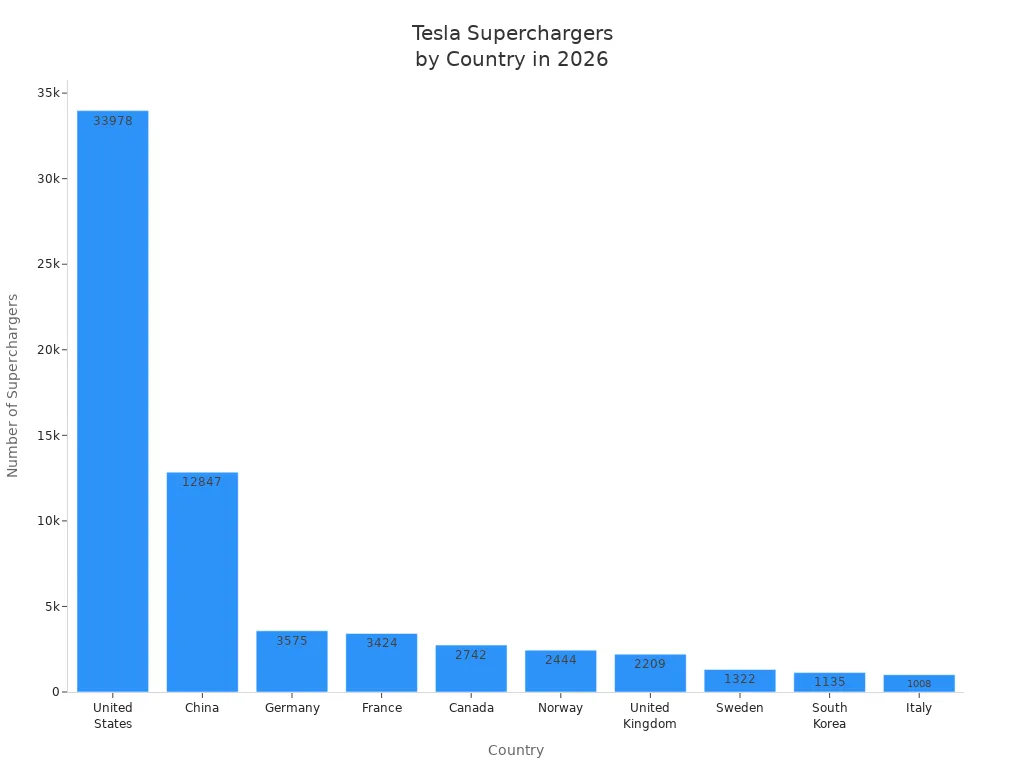
Tesla’s ultra-rapid charging fills your battery in minutes. The company keeps growing its network. Charging electric vehicles is easier for everyone now. You get a smooth charging experience. This works for Tesla cars and other compatible EVs.
ChargePoint has one of the biggest charging platforms. There are about 342,000 charging spots in North America and Europe. ChargePoint uses AI to make charging better. The platform checks how people use chargers. It helps improve charging schedules. You can join a waitlist to manage busy times. Dynamic energy management cuts costs. Smarter pricing gives you more choices.
AI helps make charging schedules better
Waitlist manages busy times
Easy station activation for new users
Dynamic energy management and flexible pricing
Dashboards show real-time information
ChargePoint works with any OCPP-compliant charger. You can control different brands in one place. Cloud architecture keeps your data safe. The company adds new features quickly. More businesses and drivers join every year. ChargePoint keeps growing and improving.
Shell Recharge wants to grow its charging station network worldwide. The company runs about 70,000 public charging points now. Shell plans to reach 200,000 stations by 2030. Shell makes partnerships, like with GAC Energy. This helps build more charging stations in places like Hong Kong. Shell’s charging facilities are in GAC’s mobile app. This makes it easier for EV users to find stations.
Partnerships help build more charging stations
Local projects support vehicle electrification
Mobile apps make charging easier for users
Shell Recharge serves drivers in Canada and the United States. More stations and better access are coming soon. Shell invests in public charging and new technology.
Siemens brings smart ideas to EV charging. PlugtoGrid™ connects chargers to the grid. It supports renewable energy. Siemens offers cloud management for fleet operations. You can use remote diagnostics and planning. Siemens gives advanced charging with smart grid integration.
PlugtoGrid™ connects chargers and supports renewables
Cloud services help manage fleets
Smart grid integration and intelligent charging software
Siemens cares about sustainability. Electrification X is part of Siemens Xcelerator. It makes ultra-fast chargepoints safer and more efficient. Siemens partners with Aral pulse in Germany. This helps create greener mobility.
Initiative | Description | Impact on Sustainability |
|---|---|---|
Electrification X | Siemens Xcelerator portfolio, improves ultra-fast chargepoints. | Makes e-mobility safer and more efficient. |
Partnership with Aral pulse | Works together to create new charging solutions in Germany. | Helps make e-mobility more sustainable. |
ABB is known for advanced charging technology. The OM X-Series gives high-power charging. It can scale from 800 kW to 10 MW. ABB uses liquid-cooled power paths. This keeps chargers working well during heavy use. The DC bus system manages power in real time.
Technology | Description |
|---|---|
OM X-Series | High-power charging, scalable from 800 kW to 10 MW. |
Liquid-Cooled | Liquid-cooled power path for good thermal management. |
DC Bus | Real-time power management across many charge points. |
OM M-Series | Started in April 2026, splits systems at the site level. |
Megawatt Charging | Supports long duty cycles and many mission profiles in one system. |
ABB follows strict certification and service rules. The company is in over 70 countries. Swiss engineering and long-term value help buyers trust ABB. Quality charging infrastructure is important.
EVBOX helps businesses with smart charging solutions. You can control how much electricity you use. Set charging priorities for your stations. Schedule power reductions during busy times. This helps companies balance energy use and costs.
Feature | Description |
|---|---|
Control maximum electric usage kWh | Balance load with set output for each station. |
Set charging priorities | Choose how stations give power to users. |
Control maximum power usage kW | Plan to lower output during peak times, like 12-4PM. |
EVBOX uses eco-friendly materials and energy management systems. The company partners with others for green charging options.
Wallbox makes charging easy at home and in public. Smart charging technology lets you watch and manage energy use. Wallbox’s Quasar product supports bidirectional charging. Your vehicle can power your home if needed.
Innovation Type | Description |
|---|---|
Smart Charging Technology | Wallbox has smart charging for home and public use. |
Bidirectional Charging | Quasar lets your car power your home, saving energy. |
Energy Management Solutions | Wallbox gives tools to monitor and manage charging. |
Wallbox helps businesses attract eco-friendly customers. Employees can charge their cars easily. Wallbox’s solutions lower your carbon footprint. They support green transportation.
Blink Charging keeps growing its charging network. The company works with partners and builds fast charging sites. In Belgium, Blink and Korian installed over 200 chargers at 90 places. Blink focuses on owned and operated DC fast charging sites. This helps earn more money and give better service.
Blink and Korian Belgium expand the network
Focus on DC fast charging infrastructure
Partnership with Emobi for roaming in North America
Blink partners with Axxeltrova and EVSTAR. These partnerships protect chargers and build better infrastructure. You get reliable charging wherever you go.
NaaS Technology brings new ideas to charging platforms. The company uses smart features and digital tools. NaaS offers automatic charging robots. There are 480KW split-type charging stacks. NaaS has 720KW liquid-cooled ultra-fast charging piles. These solutions fit different vehicles and needs.
Feature | Description |
|---|---|
Automatic Energy Supply Charging Robot | Unmanned charging with vehicle locating and parking. |
480KW Split Type Charging Stack | Charging for many vehicle types. |
720KW Liquid-Cooled Ultra-Fast Charging Pile | Adaptable to new vehicles, 100% adaptability rate. |
7KW/22KW AC Wallbox | Waterproof, impact-proof, and certified by TÜV SüD. |
Safety Features | Over 10 safety features, like current protection and self-diagnosis. |
NaaS uses AI to match supply and demand. Charging is more efficient for drivers and operators. NaaS has cut carbon emissions by over 3 million tons. The company has earned sustainability certifications.
GAC Energy is known for integrated solutions and sustainability. The company offers ultra-fast charging up to 720 kW. By the end of 2025, GAC Energy had over 23,000 charging piles. Nearly 9 million users use their stations. You can find GAC Energy stations across China and in other countries.
Ultra-fast charging up to 720 kW
Nationwide network with 23,274 charging piles
Innovations in vehicle-to-grid (V2G) technology
Largest V2G microgrid in China
GAC Energy partners with Shell Hong Kong. This expands local charging and adds services to GAC’s app. GAC Energy has cut carbon emissions by 3.43 million tons. The company delivered over 1.35 million kWh of V2G discharge. GAC Energy wants to build a low-carbon energy ecosystem. The company leads the market with reliable and advanced solutions.
These top 10 EV charging companies shape the future of charging. Each company brings something special. There is ultra-rapid charging, smart platforms, and sustainable business models. As more vehicles hit the road, these companies make sure you can always charge your car.
Company | Market Share/Global Reach |
|---|---|
Tesla | Runs one of the largest DC fast charging networks with over 75,000 connectors worldwide. |
ChargePoint | Has about 342,000 charging spots in North America and Europe. |
Shell Global | Has around 70,000 public charge points by 2025, aiming for 200,000 by 2030. |
Siemens | Expands fast charging and smart solutions for hardware and software. |
ABB | Gives high-power charging solutions but does not run a global network. |
EVBox | Offers smart business charging solutions. |
Wallbox | Known for smart technology and energy management solutions. |
Blink Charging | Expands its network and offers charging at many locations. |
NaaS Technology | Brings AI-driven platforms and sustainability achievements. |
GAC Energy | Expands ultra-fast charging and V2G technology, focusing on sustainability. |
Every year, new technology changes how you charge your car. In 2026, charging stations have many cool upgrades. Here are some of the biggest changes:
Technology Advancement | Description |
|---|---|
Ultra-Fast Charging | Charge your car to 80% in just 15-20 minutes with 350 kW+ systems. |
Bidirectional Charging | Let your car send power back to the grid and earn money when you are not driving. |
Interoperability | Use one account to access many charging networks, making travel easier for you. |
Charging-as-a-Service (CaaS) | Let experts handle your charging stations so you can focus on your business. |
Hydrogen and Multi-Fuel Hubs | Find more options for fueling, especially for heavy vehicles, at one location. |
Ultra-rapid charging is everywhere now. You can stop for a snack and fill your battery fast. Home charging is smarter too. You can watch your energy use and save money.
Good rules help you find more charging spots. Governments make laws to support ev charging. They give money to build more stations in cities and towns. These rules help companies add more chargers. Charging your electric car is easier and more reliable now. You see more stations in places you go every day.
Tip: See if your city gives rebates for home charging stations. You could save money and help the earth.
Young people like new technology and want to help the planet. This makes ev charging grow fast. More people want electric cars, so more charging stations are built. Charging is now part of city plans and new apartments. You can charge at home, at work, or on a trip. The market for charging stations keeps getting bigger. People want easy, quick, and green ways to power their cars.
You can notice these top 10 companies help ev charging grow. New technology and smart ideas make charging your car easier. There will be more stations and faster charging soon. Keep looking for news about ev charging. You may find new ideas and companies that change the future.
You can use an ultra-fast DC charger. These stations fill your battery much quicker than regular home chargers.
Yes! You just need a home charging station. Plug in your car overnight and wake up to a full battery.
Try using your car’s navigation system or a mobile app. Many apps show real-time locations and availability.


