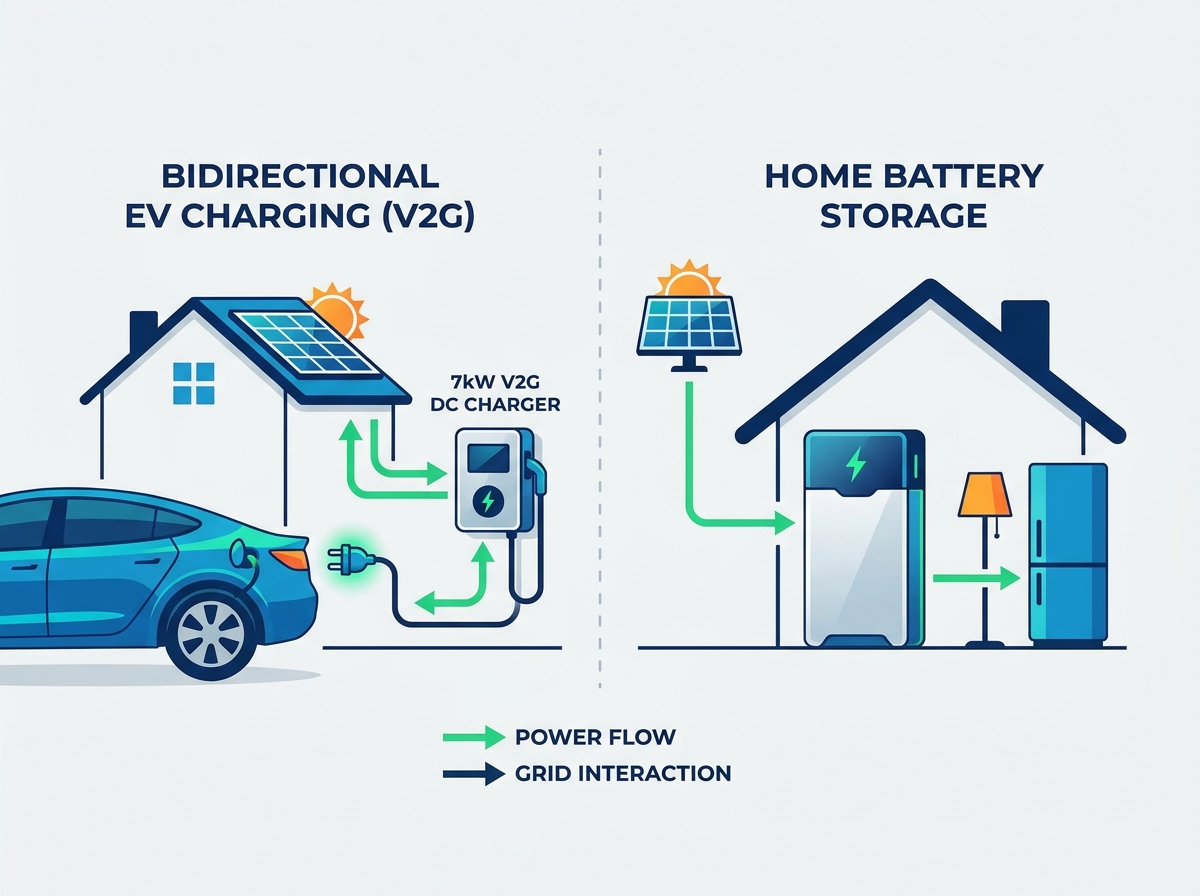
The rapid adoption of electric vehicles introduces a new energy management reality. Massive lithium-ion batteries sit idle in residential garages for most of the day. Property owners investing in energy resilience face a distinct choice. You must decide whether to install a dedicated stationary battery system or leverage your vehicle's existing capacity for backup power and grid arbitrage. Both paths offer distinct advantages but operate on entirely different infrastructure requirements.
Evaluating bidirectional EV charging vs home battery systems requires analyzing hardware availability, installation realities, lifestyle impacts, environmental footprints, and utility interconnection constraints. Making the right choice depends on your immediate resilience needs, daily driving habits, and site-specific electrical infrastructure. We will break down the field realities of both technologies to help you determine the most effective backup power strategy for your property.
Key Takeaways
Capacity Discrepancy: A standard EV battery offers 60–100+ kWh of storage, dwarfing the typical 10–15 kWh capacity of standard residential energy storage units, but with distinct availability trade-offs.
Hardware Readiness: While stationary batteries are mature, plug-and-play solutions, bidirectional charging requires specialized, currently expensive hardware (like a 7kW V2G bidirectional DC charger) and compatible vehicles.
Lifestyle Dependency: Home batteries provide uninterrupted, passive backup; bidirectional systems require the vehicle to be physically plugged in during an outage or peak pricing event.
Environmental & Solar Synergy: Utilizing an EV for home backup reduces the environmental impact of mining materials for a second battery and allows homeowners to size their solar arrays to power both their commute and their home.
Regulatory & Warranty Hurdles: Widespread Vehicle-to-Grid (V2G) adoption faces friction from utility interconnection rules and EV manufacturer warranty stipulations regarding battery degradation.
Defining the Technologies: Stationary vs. Mobile Storage
The Baseline: Residential Energy Storage
Stationary home batteries represent the established standard for residential backup power. Most modern systems utilize lithium iron phosphate (LFP) chemistries. Manufacturers choose LFP cells for their high thermal runaway threshold, lack of cobalt, and exceptional cycle life, often exceeding 6,000 cycles before significant degradation. Installers permanently mount these units to a garage wall or exterior facade, wiring them directly into the home's main electrical panel or a dedicated critical loads subpanel.
The primary functions of residential energy storage extend beyond simple emergency backup. These systems manage solar self-consumption by capturing excess daytime generation to power the house after sunset. They also execute time-of-use (TOU) load shifting, discharging stored energy during peak evening utility rates to lower grid reliance. During a grid failure, an automatic transfer switch (ATS) detects the voltage drop and physically islands the home from the utility grid. This transition happens in milliseconds, keeping sensitive electronics online without interruption.
This technology operates on mature, standardized protocols. Electrical inspectors understand the fire codes, and manufacturers provide established warranty frameworks. Once commissioned, the system operates autonomously in the background without requiring daily user intervention.
The Challenger: Bidirectional EV Charging Ecosystems
Bidirectional charging transforms the vehicle from a simple grid load into a mobile energy reservoir capable of discharging power. This ecosystem operates across three distinct tiers of power flow, each requiring different hardware and integration levels.
V2L (Vehicle-to-Load) represents the most basic format. The vehicle features standard 120V or 240V AC outlets in the cabin or truck bed. You plug individual appliances or power tools directly into the vehicle. It operates entirely independent of the home's electrical panel and requires no utility interconnection agreements.
V2H (Vehicle-to-Home) routes the vehicle's stored energy directly into the home's electrical panel during a grid outage. It requires specialized hardware, including a microgrid interconnect device (MID), to safely disconnect the house from the grid. This prevents the vehicle from backfeeding high voltage onto utility lines while lineworkers perform repairs.
V2G (Vehicle-to-Grid) involves exporting power from the vehicle back to the utility grid. Homeowners participate in demand response programs, allowing the utility to draw power from the vehicle to stabilize the local grid during peak load events. V2G requires advanced utility telemetry, strict interconnection approvals, and certified grid-tied inverters.
Capacity and Performance: Evaluating Energy Density
The Scale of EV Batteries
Electric vehicles possess a massive mathematical advantage in raw energy storage. Automakers design EV battery packs to move thousands of pounds of metal at highway speeds, requiring enormous energy density. A standard stationary home battery holds a fraction of that capacity. This discrepancy translates directly into days of available backup power for a residential property.
Storage System
Usable Capacity (kWh)
Primary Function
Estimated Backup Duration (20 kWh/day load)
Standard Home Battery (Single Unit)
10 - 13.5 kWh
Stationary Backup / Solar Shifting
0.5 to 0.75 Days
Nissan Leaf (Extended Range)
60 kWh
Transportation / V2H Capable
3 Days
Hyundai Ioniq 5
77 kWh
Transportation / V2L Capable
3.8 Days
Ford F-150 Lightning (Extended)
131 kWh
Transportation / V2H Capable
6.5 Days
The average household consumes between 20 and 30 kWh per day. A single stationary battery might carry a home through one night, assuming the homeowner disables heavy inductive loads like air conditioning or well pumps. An EV with a 100 kWh battery can power that same home for several days without any solar recharge. For properties facing extended grid failures following severe weather, the raw capacity of an EV battery provides unmatched endurance.
Discharge Rates and Peak Power
Capacity dictates how long the power lasts, but discharge rates determine what appliances you can operate simultaneously. Continuous power output and peak surge capacity are critical metrics for running heavy household loads.
Stationary batteries generally output 5 to 7 kW of continuous power per unit. Starting a 4-ton HVAC compressor requires a massive surge of instantaneous current, known as Locked Rotor Amps (LRA). A standard compressor might demand 80 to 100 amps for a fraction of a second during startup. To handle these heavy loads, installers must either install soft starters on the HVAC equipment or stack multiple stationary batteries together in parallel, increasing the system footprint.
High-output bidirectional setups rely on the rating of the off-board inverter mounted on the wall. If a bidirectional charging system pairs with a robust 10 kW or 11.5 kW inverter, a single vehicle can comfortably start and run heavy inductive loads that would otherwise overwhelm a single stationary battery module. The vehicle's high-voltage DC pack easily supplies the necessary current; the bottleneck is always the wall-mounted inverter's continuous AC rating.
Hardware, Installation, and Infrastructure Realities
Installing Dedicated Home Battery Systems
Deploying a dedicated battery bank follows a predictable construction path. Installers follow strict National Electrical Code (NEC) guidelines for energy storage systems. The installation process requires specific field modifications to the property's electrical infrastructure.
Load Calculation and Panel Sizing: Electricians audit the home's consumption to determine if a whole-home backup is viable or if a dedicated critical loads subpanel is necessary.
Mounting and Clearances: Technicians mount the battery modules and hybrid inverter, adhering to local fire code setbacks. This often dictates minimum distances from windows, doors, and gas meters.
Gateway Installation: Installers wire the automatic transfer switch (gateway) between the utility meter and the main breaker panel to enable grid islanding.
Conduit and Wiring: Electricians run EMT conduit and pull high-gauge THHN wire to connect the battery, inverter, and gateway.
Commissioning: The team configures the current transformer (CT) meters for accurate consumption monitoring and provisions the software for utility interconnection.
Requirements for Bidirectional Home EV Charging
Transforming a vehicle into a home power plant requires specialized, heavy-duty equipment. Standard Level 2 chargers simply pass AC power from the grid to the car, relying on the vehicle's onboard charger to convert it to DC. To pull power out efficiently, you need specialized hardware like a 7kW V2G bidirectional DC charger.
This equipment bypasses the car's internal AC charger entirely. It utilizes the DC pins on a CCS or CHAdeMO plug to pull high-voltage DC power directly from the vehicle's battery pack. The external charger then inverts this DC power into 240V split-phase AC and feeds it into the house. This process demands robust infrastructure upgrades compared to standard home EV charging setups.
You must install a Home Integration System (HIS). This central hub contains the isolation transformers, the microgrid interconnect device, and a dark start battery. The dark start battery is a small internal power source that wakes up the bidirectional inverter when the grid is completely down. Without it, the system cannot initiate the handshake protocol with the vehicle during a blackout. The installation demands highly specialized electricians familiar with early-stage DC integration and complex communication wiring.
Resource Allocation and ROI Timelines
Upfront Capital Expenditure (CapEx)
Evaluating the initial investment requires looking at total installed hardware requirements. A standard stationary battery system involves procuring the battery modules, the hybrid inverter, the gateway, and the associated electrical labor. The battery cells themselves represent the bulk of the hardware investment.
The V2H route shifts the hardware focus. You avoid procuring stationary battery cells, but you must acquire a V2H-capable EV, the bidirectional DC charging station, and the comprehensive home integration hardware. The heavy-duty DC charging equipment, isolation transformers, and complex labor require a significant capital allocation. The primary advantage materializes when you factor in the massive capacity you unlock by utilizing the vehicle's existing battery pack.
Grid Arbitrage and Demand Response (V2G Economics)
The operational upside of bidirectional technology lies in Vehicle-to-Grid (V2G) applications. By participating in utility Virtual Power Plants (VPPs) and demand response programs, homeowners leverage their parked vehicles as active grid assets.
Utilities face massive strain during peak afternoon and evening hours. Through V2G, you allow the utility to draw a few kilowatt-hours from your vehicle during these critical windows. In return, the utility provides compensation or bill credits. Furthermore, you achieve demand reduction by discharging the EV to power your own home during peak utility rates, then recharging the vehicle overnight during super-off-peak hours. This model extracts secondary value from a transportation asset that would otherwise sit idle.
Synergies with Residential Solar Arrays
Bidirectional charging fundamentally changes how solar contractors design residential systems. It incentivizes homeowners to size their solar arrays to cover both household consumption and the vehicle's commuting mileage.
This synergy maximizes solar self-consumption. Homeowners capture excess daytime solar generation directly into the EV's massive battery, preventing solar clipping when generation exceeds household demand. When the sun goes down, the bidirectional charger pulls that stored solar energy back out of the car to power the home at night. This loop effectively utilizes the vehicle as a massive solar sponge, maximizing the value of every kilowatt-hour generated on the roof.
Implementation Risks and Lifestyle Trade-offs
The "Empty Driveway" Problem (Availability Risk)
The primary vulnerability of V2H and V2G systems is availability. A stationary battery is always bolted to your wall, ready to deploy power the second the grid fails. An EV is a mobile asset subject to commuting schedules.
If a severe storm knocks out the power grid while you are at work or running errands, your home has zero backup power. The "empty driveway" problem means refrigerators lose cooling, medical devices shut down, and security systems fail until the vehicle returns and is physically plugged in. Realizing the benefits of grid arbitrage also requires aligning your driving schedules with peak utility pricing windows. If the car is never home between 4 PM and 9 PM, you cannot participate in evening demand response programs.
Safety Profiles and Environmental Impact
From an environmental standpoint, bidirectional charging offers superior resource efficiency. Utilizing an existing EV battery for home backup significantly reduces the need to mine new lithium, cobalt, and raw materials. Manufacturing a secondary stationary battery to hang on a wall when a massive battery already sits in the garage is fundamentally inefficient from a global resource perspective.
Regarding safety, both technologies undergo rigorous testing. Wall-mounted stationary batteries must pass UL 9540 and UL 9540A thermal runaway fire tests. Modern EVs feature advanced, active liquid-cooled Battery Management Systems (BMS) designed to withstand extreme highway conditions and rapid DC fast charging. These robust thermal management systems make EVs exceptionally safe energy reservoirs when parked in a residential garage.
Battery Degradation and Warranty Implications
Using a vehicle to power a home or stabilize the grid introduces micro-cycling. This frequent, shallow charging and discharging adds workload to the lithium-ion pack, potentially impacting its long-term lifespan.
Automakers tightly control their battery warranties, which typically cover 8 years or 100,000 miles. Currently, many EV manufacturer warranties explicitly void battery coverage if the vehicle is used for V2G applications without approved hardware. Some forward-thinking manufacturers allow a specific megawatt-hour (MWh) throughput limit per year for bidirectional use. Early adopters must carefully read warranty stipulations to avoid voiding their vehicle's powertrain coverage.
Utility Interconnection and Regulatory Hurdles
Pushing power back onto the grid is heavily regulated. Any equipment that exports power must meet strict IEEE 1547 and UL 1741 SA/SB certification requirements for grid-tied inverters. This ensures the equipment safely disconnects during an outage, preventing dangerous backfeeding that could electrocute utility lineworkers.
Local utilities may block or delay V2G interconnection applications due to grid stability concerns at the local transformer level. Furthermore, many utility territories lack standardized metering protocols to accurately measure and compensate mobile batteries that might charge at one location and discharge at another. Securing Permission to Operate (PTO) for a bidirectional system often involves navigating significant bureaucratic friction.
Decision Framework: Which Solution Fits Your Energy Profile?
When to Choose Dedicated Home Battery Storage
Stationary batteries remain the optimal choice for specific operational profiles. You should invest in dedicated wall-mounted storage if:
Your area experiences frequent, unpredictable power outages, such as rolling blackouts or sudden storm damage.
You work from home and require uninterrupted uptime for servers, medical equipment, or security systems.
The household EV is frequently away from home during the day or evening.
You prefer a proven, automated system that requires no physical interaction to function during an emergency.
When to Invest in Bidirectional EV Charging
Leveraging your vehicle as a power plant makes sense for users with different resilience priorities. You should pursue bidirectional hardware if:
You require high-capacity backup for extended, multi-day outages where a small stationary battery would quickly deplete.
Your EV is consistently parked at home during peak utility hours.
You are willing to navigate early-adopter hardware installations and participate in utility pilot programs.
You want to minimize your environmental footprint by avoiding the procurement of redundant lithium-ion batteries.
The Hybrid Approach
An emerging strategy among energy resilience experts is the hybrid approach. This involves installing a small stationary battery supplemented by a bidirectional EV charger.
The small stationary battery handles immediate, seamless transitions during micro-outages and keeps critical loads running if the car is away. When a multi-day outage strikes, the homeowner plugs in the EV, and the bidirectional charger takes over the heavy lifting, providing massive long-term capacity. This hybrid design offers guaranteed instant uptime and virtually unlimited backup duration.
Conclusion
Bidirectional EV charging offers unparalleled capacity, a lower environmental impact, and long-term economic potential through grid arbitrage. However, dedicated home batteries remain the only reliable, plug-and-play solution for guaranteed 24/7 resilience today. The choice ultimately comes down to whether you prioritize immediate, automated backup or massive, mobile energy capacity.
Base your decision on immediate resilience needs versus timeline flexibility. If you need guaranteed backup for this upcoming storm season, install a stationary battery. The technology is proven, available, and installs quickly. If you are planning for future vehicle upgrades, prep your electrical panel for bidirectional hardware, run the necessary conduit, and size your solar array to accommodate future vehicle charging.
Take the following steps to finalize your energy strategy:
Conduct a comprehensive home energy audit to determine your critical load requirements and daily kWh consumption.
Verify the specific bidirectional capabilities (V2L vs V2H) of your current or planned EV, ensuring it supports off-board DC discharging.
Check with your local utility providers for active V2G pilot programs, available equipment rebates, or specific interconnection restrictions.
Consult with a certified electrical contractor to assess your main panel's busbar capacity for a Home Integration System.
FAQ
Q: Does bidirectional EV charging ruin the car's battery?
A: Bidirectional charging introduces micro-cycling, which adds wear to the battery. However, modern EVs feature advanced Battery Management Systems (BMS) that tightly control discharge depths and thermal limits to minimize degradation. While excessive V2G grid exporting can accelerate wear, occasional V2H backup use has a negligible impact on long-term battery health. Always verify your manufacturer's warranty stance on bidirectional use.
Q: Can I use any EV for V2H or V2G?
A: No. Only specific models currently support true bidirectional power flow. This requires both software enablement from the automaker and compatible DC hardware. Current examples include the Nissan Leaf and Ford F-150 Lightning. The industry is shifting toward standardized CCS bidirectional protocols, meaning most new EVs released in the coming years will likely support this technology natively.
Q: How much does a 7kW V2G bidirectional DC charger cost?
A: The investment depends on the hardware scope rather than a fixed price. You must account for the charger unit, the home integration system, isolation transformers, and extensive electrical labor. Because these systems contain heavy-duty internal inverters to convert DC power from the car back to AC for the home, they require a larger initial capital allocation compared to standard Level 2 setups.
Q: Will a bidirectional charger work if the grid goes down?
A: Yes, but only if you have the correct integration hardware installed. A bidirectional charger requires a Home Integration System and an automatic transfer switch. These components safely island your home, physically disconnecting it from the utility grid during an outage. This prevents your vehicle from backfeeding power onto neighborhood power lines, which could endanger utility repair crews.
Q: Is it cheaper to buy a home battery or a bidirectional charger?
A: Evaluating the financial outlay requires looking at total hardware requirements. A standalone home battery requires fewer integration components. Bidirectional systems demand heavy-duty inverters and transfer switches, increasing the initial equipment scope. However, leveraging the vehicle's existing battery capacity often provides a superior return on resource allocation for high-capacity needs.
Q: Do I need solar panels to use bidirectional EV charging?
A: Solar panels are not strictly required for V2H backup; you can charge your EV from the grid and discharge it to your home during an outage. However, pairing V2G with a properly sized solar array maximizes your system's efficiency. It allows you to capture solar energy during the day, store it in the car, and use it to power your home at night.
Q: What is the difference between V2H and V2G?
A: V2H (Vehicle-to-Home) involves powering your home behind the utility meter. You use the car's battery to run your own appliances during an outage or peak pricing hours. V2G (Vehicle-to-Grid) involves exporting power in front of the meter back to the utility grid. V2G allows you to participate in utility demand response programs and stabilize the local grid.