Retrofitting an existing commercial property for EV charging introduces complex financial and structural variables rarely encountered in new construction projects. Facility managers and property owners frequently budget primarily for the charging hardware, severely underestimating the compounding costs of trenching, electrical panel upgrades, mandatory site compliance, and long-term maintenance. To accurately forecast the total EV charging station retrofit cost, decision-makers must evaluate the specific hard costs, soft costs, and operational expenditures associated with bringing legacy infrastructure up to modern high-voltage standards. You need a clear view of what happens when you cut into decades-old asphalt or open up an aging electrical room. We will break down the exact site conditions and infrastructure demands that dictate your final capital expenditure.
Hardware typically accounts for only 20–30% of the total retrofit budget; civil works and charging site electrical upgrades dictate the final capital expenditure.
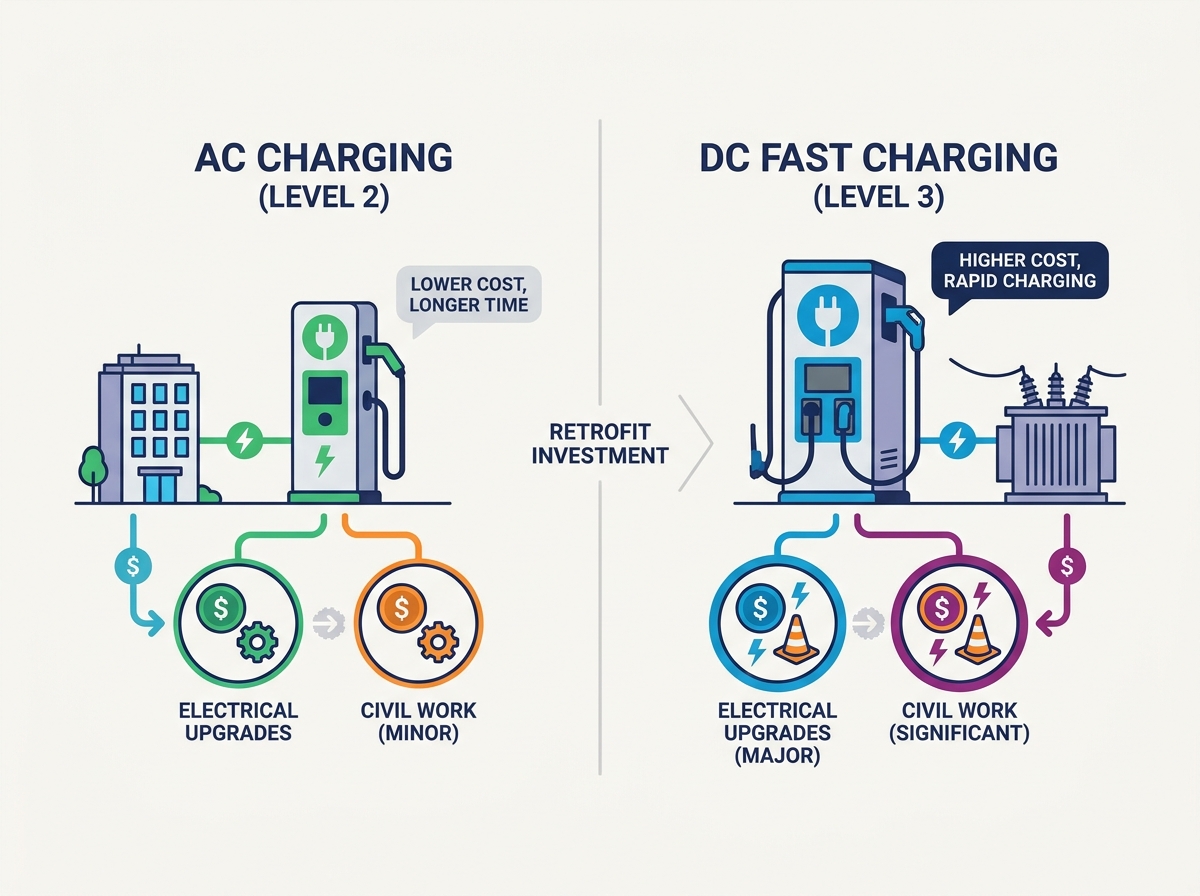
The choice between an AC and DC charger fundamentally alters the scope of the project, requiring vastly different grid capacities, thermal management systems, and baseline equipment investments.
Hidden site conditions—such as underground utility conflicts, soil remediation, and asphalt repaving—are the leading causes of budget overruns in commercial retrofits.
Strategic placement of chargers relative to existing electrical rooms can reduce trenching and conduit costs by up to 50%.
Framing the Retrofit Challenge: Why Existing Sites Cost More
New Build vs. Retrofit Economics
When you build a new facility, laying conduit is simple. Crews drop PVC pipes into open trenches before the grading is finished and the asphalt is poured. Retrofitting an existing parking lot is a completely different animal. You have to saw-cut through established hardscape, excavate compacted soil, and dodge a maze of legacy utility lines, irrigation pipes, and communication cables. Once the new infrastructure is in the ground, you face the heavy burden of asphalt patching, concrete pouring, and restriping to restore the parking area. These compounding civil requirements drastically elevate the baseline expenditure compared to greenfield installations.
Success Criteria for a Profitable Retrofit
A successful installation requires strategic planning. You want to maximize daily utilization rates while minimizing disruption to existing facility operations during construction. Designing the site layout to accommodate vehicle flow without creating parking bottlenecks is a priority. The infrastructure must handle future fleet expansions or increased tenant demand without requiring a complete redesign of the electrical distribution system later.
The Make-Ready Concept
Implementing a make-ready strategy controls future capital expenditures. This means oversizing the underground infrastructure during the initial retrofit phase. By laying larger conduit, pulling higher-capacity wire, and pouring extended concrete pads upfront, you can accommodate additional charging units later without breaking ground a second time. This approach slightly increases the initial material expenses but entirely eliminates the mobilization and trenching fees associated with subsequent expansion phases.
Labor Rates and Prevailing Wage Impacts
Commercial electrical work for high-voltage applications requires specialized labor. Navigating heavy-gauge wire pulls, complex switchgear terminations, and utility transformer connections demands highly trained electricians. Projects leveraging federal grants or state-level incentives often trigger prevailing wage stipulations and union labor requirements. These mandatory labor standards elevate hourly rates compared to standard commercial maintenance tasks, requiring strict adherence to certified payroll reporting and compliance documentation.
Hardware Selection: AC and DC Charger Cost Baselines
Level 2 (AC) Chargers: Costs and Capabilities
Commercial-grade Level 2 equipment represents a moderate initial capital outlay, making it highly accessible for widespread deployment. These units operate on standard commercial voltages and deliver a steady, reliable charge over several hours. They fit perfectly in locations where vehicles remain parked for extended durations. Ideal use cases include workplace parking garages, multi-family residential complexes, and hospitality venues where drivers expect to charge overnight or during a full shift. The lower power draw means these units can often integrate into existing electrical panels with minimal disruption.
Deploying Level 3 infrastructure requires a premium equipment investment. These units bypass the vehicle's onboard converter to deliver direct current straight to the battery, enabling rapid charging sessions. This high-output performance demands heavy-duty liquid-cooled cables, significantly larger physical footprints, and advanced internal networking hardware to manage thermal loads. The sheer weight and size of these units necessitate robust concrete foundations and dedicated clearance zones for maintenance access, adding layers of complexity to the physical installation.
Evaluating Hardware-to-Outcome Fit
Matching the hardware to the specific business model is a foundational step in controlling the overall commercial EV charging station budget. If the goal is to provide an employee perk or support a fleet of overnight delivery vans, Level 2 units offer the most efficient alignment of capability and expense. If the objective is to create a revenue-generating public charging hub along a major highway corridor, the high throughput of DC fast charging is mandatory to achieve desired vehicle turnover rates. Selecting the wrong hardware tier leads to either stranded capital or frustrated users facing inadequate charging speeds.
Feature
Level 2 (AC) Charging
Level 3 (DC Fast) Charging
Typical Dwell Time
4 to 8 hours
20 to 60 minutes
Electrical Requirements
Standard commercial voltage (208V/240V)
High voltage (480V 3-phase)
Infrastructure Footprint
Minimal, wall-mounted or standard pedestal
Large, requires heavy concrete pads and clearance
Primary Use Case
Workplaces, apartments, hotels
Highway corridors, fleet depots, retail hubs
Charging Site Electrical Upgrades: The Largest Budget Variable
Assessing Existing Electrical Capacity
Before you order any hardware, engineers must conduct a rigorous assessment of the facility's existing electrical capacity. This process typically involves a 30-day load study, where data loggers attach to the main distribution panel to record peak power consumption over a full month. Because EV charging introduces a continuous, non-coincident load, the National Electrical Code requires strict safety margins. If the load study reveals insufficient spare amperage, the facility cannot safely support the new equipment without comprehensive upstream modifications.
Switchgear, Transformers, and Panel Upgrades
When existing capacity falls short, upgrading the main distribution panels becomes unavoidable. Replacing aging switchgear to handle continuous heavy loads is a major undertaking that requires facility downtime and extensive utility coordination. In many cases, particularly when deploying high-output infrastructure, the existing utility feed is entirely inadequate. This necessitates the installation of a dedicated utility step-down transformer. Engineering a new transformer pad, securing utility approvals, and executing the high-voltage tie-in introduces substantial infrastructure expenses that often eclipse the cost of the charging units themselves.
Conduit Runs and Wire Sizing
The physical distance between the electrical room and the parking lot directly dictates material expenses. Long conduit runs require heavy-gauge copper wiring to prevent voltage drop, ensuring the equipment receives the precise voltage required for optimal operation. Copper is a highly volatile commodity, and long pulls of thick-gauge wire add massive material overhead. Engineers must carefully calculate wire sizing based on distance, ambient temperature, and conduit fill limits. Strategic placement of the charging islands as close to the power source as possible is the most effective way to mitigate these extensive material requirements.
Here are practical steps to manage electrical upgrade scopes:
Mount data loggers on your main switchgear during peak operational months to get an accurate baseline.
Request as-built electrical drawings from your property management team to identify existing conduit pathways.
Consult with your utility provider early to determine the maximum capacity of the pole-mounted or pad-mounted transformer feeding your building.
Position the charging stations on the side of the parking lot closest to the main electrical room to shorten wire runs.
Civil Works and Construction: Uncovering Hidden Site Costs
Trenching, Boring, and Asphalt Restoration
Routing power from the electrical room to the parking lot requires significant civil engineering. Open trenching is the traditional method, involving heavy machinery to cut through asphalt, excavate trenches, and lay conduit. This method incurs high per-linear-foot expenses for debris haul-away, backfilling, and repaving. Alternatively, horizontal directional boring allows contractors to tunnel underneath the hardscape, preserving the existing surface. While boring requires specialized equipment and carries a higher mobilization fee, it often proves more economical by eliminating the need for extensive asphalt restoration and minimizing disruption to daily traffic flow.
Concrete Pads, Bollards, and Physical Protection
Charging equipment cannot simply be bolted to existing asphalt. Contractors must excavate and pour reinforced concrete equipment pads designed to support the specific weight and footprint of the chosen hardware. These pads require precise rebar grids and pre-set anchor bolt templates to ensure structural integrity. The investment must also be protected from vehicle strikes. Installing heavy-duty, concrete-filled steel bollards around the perimeter of the charging islands is a mandatory safety requirement that adds another layer of civil construction to the project scope.
ADA Compliance and Parking Lot Reconfiguration
Altering a commercial parking lot triggers strict municipal accessibility requirements. Retrofitting a site for EV charging often mandates comprehensive civil engineering to achieve ADA compliance. This includes regrading the asphalt to meet specific slope tolerances for wheelchair accessibility, widening adjacent parking stalls, and restriping the lot. Contractors must ensure a compliant, unobstructed path-of-travel from the charging station to the facility entrance, which may require pouring new concrete ramps and installing tactile warning strips. Failing to account for these mandatory civil upgrades is a primary cause of budget shortfalls.
Soft Costs: Permitting, Utility Interconnection, and Engineering
Site Engineering and Architectural Drawings
Municipalities require highly detailed documentation before issuing construction permits. Deploying infrastructure involves commissioning stamped electrical and civil engineering plans. Electrical single-line diagrams must clearly illustrate load calculations, breaker sizing, and wire specifications. Civil drawings must detail trenching pathways, concrete pad dimensions, and ADA compliance measures. Engaging licensed architectural and engineering firms to produce these comprehensive drawing packages is a non-negotiable soft cost that must be factored into the initial feasibility phase.
Utility Coordination and Grid Upgrade Fees
Engaging the local utility provider early in the process is critical, as grid-side upgrades introduce hidden financial liabilities. If the local grid lacks the capacity to support the new continuous load, the utility may require line extensions, upgraded pole-mounted transformers, or new underground primary feeds. Facilities are often responsible for covering these utility-side upgrade fees. Engineering a new transformer pad to utility specifications requires exact adherence to clearance codes and grounding requirements, adding administrative and financial overhead to the deployment.
Municipal Permitting and Inspection Timelines
The administrative burden of securing municipal approvals can severely impact project timelines. Permitting departments often require multiple rounds of revisions for high-voltage commercial installations. Prolonged permitting processes delay equipment deployment and increase carrying costs for the project. Once construction is complete, the site must pass a series of rigorous inspections—including rough-in electrical, civil, and final utility sign-offs—before the equipment can be energized. Navigating this bureaucratic landscape requires dedicated project management resources.
Beyond CapEx: Software, Maintenance, and Operational Costs (OpEx)
Charge Point Management Systems (CPMS)
Modern charging infrastructure relies on sophisticated cloud-based software to function efficiently. Implementing a Charge Point Management System (CPMS) incurs recurring SaaS fees that must be budgeted annually. This software handles vital operational tasks, including secure payment processing, user authentication, and dynamic load balancing to prevent grid overloads. The CPMS provides facility managers with remote diagnostic capabilities, allowing them to monitor equipment health, track energy consumption, and generate detailed utilization reports in real time.
Preventative Maintenance and SLAs
Treating charging infrastructure as a set-it-and-forget-it asset inevitably leads to prolonged downtime. Budgeting for robust annual preventative maintenance contracts is essential. High-output units require regular filter replacements, coolant top-offs, and thermal system inspections to prevent overheating. Establishing Service Level Agreements (SLAs) with qualified technicians ensures rapid response times for hardware failures. Investing in extended warranties and proactive maintenance schedules is the only reliable way to prevent expensive equipment from becoming stranded, non-functional assets.
Cellular Networking and Connectivity
Reliable internet connectivity is the backbone of commercial charging operations. Without a stable connection, units cannot process payments, authenticate users, or communicate with the central management dashboard. Facilities must secure robust 4G or 5G cellular networking plans for each charging island. In areas with poor cellular reception, deploying hardwired ethernet connections or localized Wi-Fi mesh networks becomes necessary, adding ongoing IT management and data subscription fees to the operational budget.
Key operational expenses to track include:
Annual software licensing fees per charging port.
Cellular data plans for remote monitoring and payment gateways.
Scheduled preventative maintenance visits and consumable parts.
Extended hardware warranties to cover major component failures.
ROI and Profitability: Justifying the Retrofit Investment
Direct Revenue Generation
Establishing a strategic tariff structure allows facilities to recoup electricity expenses and generate direct operational profit. Property owners can configure the management software to bill users per kilowatt-hour consumed or per minute connected. You must factor in peak demand charges levied by the utility when setting these rates. Dynamic pricing models—where tariffs increase during peak grid hours—help offset elevated electricity rates and encourage drivers to move their vehicles promptly once charging is complete, maximizing hardware turnover.
Indirect ROI and Dwell Time
Beyond direct charging revenue, the infrastructure serves as a powerful magnet for high-value demographics. Retail centers, coffee shops, and entertainment venues utilize charging availability to attract EV drivers who typically possess higher disposable incomes. Because charging takes time, these drivers remain on-site longer, directly increasing customer dwell time and driving secondary spending inside the facility. This indirect return on investment often outpaces the direct revenue generated by the charging sessions themselves.
Tenant Retention and Property Value
In the commercial real estate sector, offering reliable charging infrastructure is rapidly transitioning from a luxury amenity to a baseline requirement. Corporate tenants increasingly demand workplace charging to support their own sustainability goals and employee retention strategies. Property owners who proactively retrofit their facilities can command premium lease rates, improve tenant retention, and significantly elevate the overall market value of their real estate portfolio in a competitive landscape.
Implementation Risks and Cost Mitigation Strategies
Navigating Supply Chain Delays
The global demand for high-voltage electrical components has created severe supply chain bottlenecks. Lead times for commercial switchgear, heavy-duty breakers, and utility transformers can stretch for several months. Failing to account for these delays results in stalled construction and contractor standby fees. To mitigate this risk, project managers must sequence phases carefully, securing long-lead electrical components well before breaking ground on the civil works. Proactive procurement strategies prevent half-finished sites from sitting idle.
Phased Rollouts vs. All-at-Once Deployment
Deciding between a phased rollout and an all-at-once deployment requires balancing immediate capital constraints against long-term economies of scale. Installing a few chargers initially minimizes upfront expenditure but guarantees higher per-unit civil costs when expanding later. Building out the entire site capacity at once leverages massive economies of scale in trenching, concrete pouring, and electrical panel upgrades. For most commercial applications, executing all underground civil work upfront while phasing the actual hardware installation offers the most prudent financial compromise.
Leveraging Utility Rebates and Federal Incentives
A variety of federal, state, and utility-level incentives exist to offset capital expenditures. Programs like the NEVI formula funds, IRA tax credits, and local utility make-ready rebates can absorb a significant portion of the infrastructure burden. These funds come with strict compliance strings attached. Facilities must often guarantee stringent uptime metrics, adhere to prevailing wage laws, and utilize specific certified hardware to qualify. Navigating the application and compliance reporting processes requires meticulous administrative oversight to ensure the funds are successfully secured and retained.
To move your commercial charging project from concept to execution, take the following immediate actions:
Install data loggers on your main electrical panel to capture a 30-day load profile and determine your exact spare amperage.
Walk the site with a civil engineer to map out the shortest conduit pathways and identify any ADA compliance triggers in your parking lot.
Submit a preliminary load request to your local utility provider to verify if the grid can support your anticipated power draw without requiring a new transformer.
Secure quotes from turnkey EPC contractors who include full site engineering and permitting in their scope of work.
FAQ
Q: What is the average EV charging station retrofit cost for a commercial parking lot?
A: The total expenditure depends heavily on site conditions rather than just the hardware. Civil works, electrical panel upgrades, and trenching are the primary financial drivers. Cutting through existing asphalt, pouring new concrete pads, and upgrading switchgear require extensive labor and materials. The actual charging units represent only a fraction of the total project budget.
Q: How much do charging site electrical upgrades typically cost?
A: Electrical upgrades vary based on existing capacity. If your facility requires a new main distribution panel or a dedicated utility step-down transformer, the expenses will be substantial. Long conduit runs requiring heavy-gauge copper wiring also add significant material overhead. A 30-day load study is necessary to determine the exact scope of electrical work required.
Q: What is the price difference between installing an AC and DC charger?
A: High-output direct current units require significantly more electrical capacity, dedicated transformers, and larger reinforced concrete foundations. This makes their installation far more complex, disruptive, and resource-intensive than deploying standard alternating current units. AC chargers can often tie into existing electrical panels with minimal disruption, resulting in a much lower overall installation expenditure.
Q: Can my existing commercial electrical panel support EV charging?
A: It depends entirely on your current spare capacity. Because charging introduces a continuous, heavy power draw, a 30-day electrical load study is required by code to determine if your existing panel can safely handle the additional demand without tripping main breakers or violating safety margins.
Q: What are the hidden civil engineering costs in an EV retrofit?
A: Unforeseen underground utility conflicts, soil remediation, extensive asphalt repaving, and mandatory ADA compliance upgrades frequently catch facility managers off guard. Regrading slopes, pouring new wheelchair ramps, and restriping parking stalls are common requirements that lead to significant budget overruns if not identified early.
Q: How long does it take to get utility interconnection approval for DC fast chargers?
A: Securing utility approval can take several months. The timeline depends on whether the local grid has the capacity to support the new continuous load. If the utility needs to engineer and install line extensions, upgraded pole-mounted transformers, or new underground primary feeds, the interconnection process will be significantly delayed.