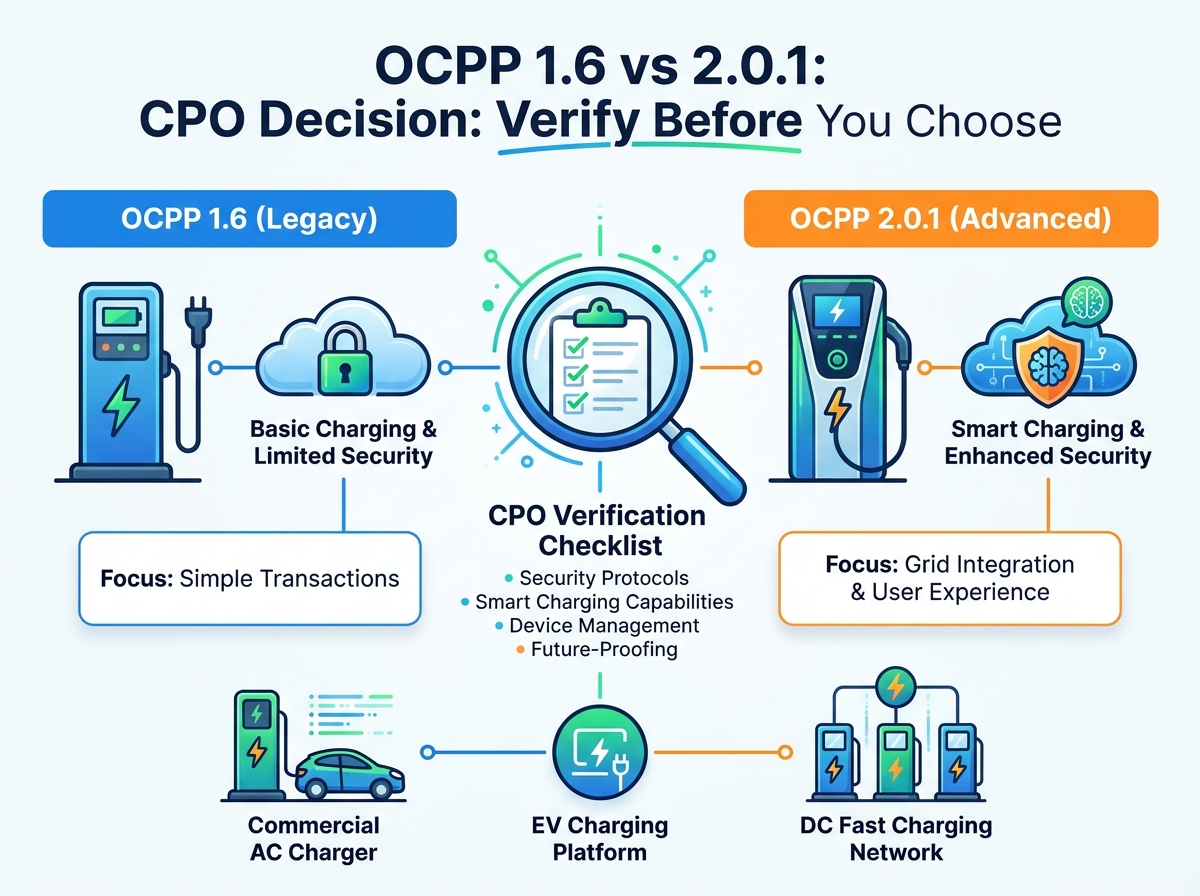
Charge Point Operators often fall into a common procurement trap. You review a hardware specification sheet, see the phrase "OCPP compliant," and assume native interoperability across your network. This assumption leads to severe operational bottlenecks. The current protocol transition presents a massive challenge. Operators scale infrastructure rapidly but face a hard fork in technology. Investing heavily in legacy standards risks rapid obsolescence as grid demands evolve. Conversely, mandating the newest standard limits available hardware options and introduces integration friction during deployment.
This article provides a technical and operational evaluation framework. We help you assess the trade-offs between protocols, ensuring hardware choices align with long-term network viability. By understanding the structural differences, you can align procurement strategies with actual field requirements, minimizing downtime and maximizing asset utilization.
No Backwards Compatibility: An OCPP 2.0.1 Central System (CPMS) cannot natively communicate with an OCPP 1.6 charger without translation layers or middleware, creating immediate architectural constraints.
Security and Device Management: OCPP 2.0.1 introduces mandatory, robust security profiles and highly flexible device management capabilities that significantly reduce truck rolls compared to the rigid structures of 1.6.
Smart Charging Nuances: The handling of charging profiles and precedence rules fundamentally shifts between versions, impacting grid-balancing strategies.
Verification is Mandatory: "OCPP Supported" is a starting point, not a guarantee. Rigorous end-to-end testing between the specific hardware firmware and the EV charging platform is required before bulk procurement.
The Architectural Shift: Framing the Decision
Defining the Baseline (OCPP 1.6)
The industry currently relies heavily on the 1.6 standard. It utilizes JSON over WebSockets, providing a reliable but structurally rigid communication method. The standard achieved widespread adoption because it solved the initial need for basic remote start, stop, and billing functionalities. However, it relies on predefined key-value pairs. This rigid structure limits the ability to handle complex data payloads.
When a connector fails in the field, the legacy protocol often sends a generic fault code. You do not know if the failure stems from a broken physical latch, a tripped internal breaker, or a faulty temperature sensor. When operators need specific hardware diagnostics, the protocol requires downloading entire log files via FTP rather than querying individual components. Security was not natively built into the core architecture. It was added later through security whitepapers, leading to fragmented implementation across different hardware manufacturers.
The Modern Framework (OCPP 2.0.1)
The newer standard represents a complete structural overhaul. It shifts away from rigid message types to a highly flexible component-variable model. This architecture allows operators to define specific components within a charging station and query the exact variables associated with them. It enables precise hardware verification, granular state monitoring, and optimized data payloads.
Instead of requesting a massive block of diagnostic data, the system can ask for the exact temperature of a specific power module or the rotational speed of a cooling fan. This targeted approach reduces cellular bandwidth consumption and provides immediate, actionable insights for maintenance teams. You can monitor the health of internal contactors and predict failures before they cause station downtime.
The Compatibility Chasm
Operators must explicitly address the lack of backwards compatibility. The structural differences mean a modern backend cannot natively speak to older hardware. Assessing the differences in OCPP 1.6 vs OCPP 2.0.1 requires understanding this communication gap. Bridging the gap usually involves translation proxies or dual-stack architectures.
Translation proxies intercept messages and rewrite them. This introduces latency risks and potential data loss during complex transactions. Dual-stack systems run both protocols simultaneously, increasing hosting requirements and complicating software maintenance. Neither workaround is perfect, making the initial hardware selection a foundational element for long-term network stability.
Core Evaluation Dimensions: Features to Operational Outcomes
Advanced Device Management and Real-Time Diagnostics
Device management dictates the frequency of physical maintenance visits. The legacy protocol handles diagnostics bluntly. Operators typically trigger a diagnostic upload, wait for the station to compile a massive log file, and then parse that file manually to find the fault. This process is slow and consumes significant cellular data. The modern protocol introduces granular, real-time monitoring through the component-variable model. Operators can track status continuously and query specific variables instantly.
If a station reports a fault, the operator can query the internal temperatures, specific module error codes, or fan speeds in real-time. This capability drastically reduces maintenance costs. Technicians arrive on-site knowing exactly which part needs replacement. Integrating these capabilities into a robust EV charging platform ensures maximum uptime and significantly lowers the operational burden on support teams.
Smart Charging and Grid Integration
Managing power output dynamically is essential for sites with constrained grid capacity. The legacy standard uses rigid charging profiles. It applies limits based on simple precedence rules, often overriding local constraints if a central command is received. This can lead to tripped breakers if the central system loses connection or miscalculates the local load.
The updated protocol handles charging profiles with far greater nuance. It introduces complex, localized load balancing. The station itself can manage power distribution among multiple connectors based on predefined local rules, even if the connection to the central system drops. Profile precedence rules are strictly defined, ensuring that grid limits always override user-level or central-level requests. This localized intelligence is vital for scaling infrastructure in areas with limited power availability.
Security, Cryptography, and ISO 15118
Security posture varies wildly between the two standards. The older protocol relies on optional security implementations. Many deployed stations still use unencrypted WebSockets, leaving them vulnerable to interception. The newer standard makes secure firmware updates, Transport Layer Security (TLS), and client-side certificates foundational requirements. A station cannot claim compliance without supporting these cryptographic standards.
Furthermore, the modern protocol natively supports Plug and Charge (ISO 15118). It handles the complex certificate exchanges required to authenticate a vehicle automatically. The legacy standard requires proprietary workarounds or external clearinghouses to achieve similar functionality. For automated payment authorization and future vehicle-to-grid (V2G) integration, the foundational security of the newer protocol is an absolute requirement.
Customer Experience and Tariff Transparency
End-user experience relies heavily on transparent pricing. The legacy protocol struggles with dynamic pricing displays. Pushing complex tariff structures or real-time pricing updates to a charger screen often requires custom, non-standard messages. This complicates compliance with emerging local regulations that mandate clear, upfront pricing displays.
The newer standard includes dedicated tariff and display message modules. Operators can push complex, multi-tiered tariff structures directly to the hardware. The station can calculate the exact cost in real-time and display custom messages directly on the screen. This native capability ensures regulatory compliance and builds trust with drivers.
Basic profile precedence; relies heavily on central system.
Advanced local load balancing; strict, complex precedence rules.
Plug and Charge
Requires proprietary workarounds or external systems.
Native ISO 15118 support for seamless certificate exchange.
Tariff Display
Limited native support; relies on custom data transfers.
Dedicated modules for complex tariffs and real-time screen updates.
Hardware Procurement: Matching Protocols to Deployment Types
Commercial AC Charger Deployments
Deploying Level 2 destination charging requires a careful assessment of site requirements. These locations operate with lower power outputs and longer dwell times. The advanced diagnostic features of the modern protocol are not always strictly necessary for a standard commercial AC charger. The hardware is generally simpler, with fewer internal components that require real-time monitoring.
Consider a 20-pedestal deployment at an apartment complex. The primary failure modes are usually physical vandalism or basic contactor wear. You do not necessarily need real-time telemetry on internal inverter temperatures because there is no internal inverter. The maturity and lower cost of legacy hardware still present a viable business case here. Multi-family housing, workplace charging, and hospitality sectors often prioritize initial capital expenditure over advanced vehicle-to-grid capabilities. If the site does not require complex tariff displays or Plug and Charge functionality, the older standard remains a practical choice for bulk deployments.
DC Fast Charging Network Requirements
High-power hubs operate under entirely different constraints. They require high-data throughput to manage complex internal systems. Liquid-cooled cables, multiple power modules, and dynamic power sharing demand constant monitoring. Building a future-proof DC fast charging network practically mandates the modern protocol. The granular diagnostics are essential for identifying a failing power module before it takes the entire station offline.
A 350kW liquid-cooled dispenser requires intense oversight. If the coolant pump loses pressure, the cable overheats in seconds. The legacy protocol might just send a generic faulted status. The modern protocol allows the station to report the exact coolant pressure drop, enabling the backend to derate the charger to 50kW instantly, keeping the station online while alerting maintenance.
Furthermore, the intersection of North American Charging Standard (NACS) connector adoption and protocol versions requires specific procurement checks. While the physical connector is separate from the backend communication, managing mixed-connector sites introduces integration risks. The modern protocol handles multiple connectors, complex authorization lists, and Plug and Charge expectations far more elegantly. Operators must verify that NACS-equipped hardware fully supports the advanced authorization and security modules of the newer standard to ensure a flawless driver experience.
Implementation Risks and Mitigation Strategies
The "OCPP Supported" Trap
Vendor specification sheets often contain misleading language. A charger claiming "OCPP 2.0.1 support" might only support the core profile. It may completely ignore optional modules like advanced smart charging, local authorization lists, or tariff displays. This partial implementation destroys the anticipated benefits of upgrading.
Operators must deconstruct these claims by interrogating vendor Protocol Implementation Conformance Statements (PICS). The PICS document details exactly which messages and modules the hardware actually supports. Procurement teams must cross-reference the PICS against their specific operational requirements. If tariff transparency is required, the PICS must explicitly show support for the Tariff and Cost module. Do not accept verbal assurances; demand the documentation.
Integration Testing with Your Platform
Paper verification is insufficient. Operators must establish a mandatory testing protocol. Before committing to a bulk purchase, CPOs must physically test the hardware in a sandbox environment. This testing must go beyond basic start and stop commands.
Engineers must verify edge cases. They should simulate network drops to see how the station handles transaction recovery when the connection is restored. They must test firmware rollbacks to ensure a failed update does not brick the hardware. They should also force hardware faults to verify that the correct diagnostic variables are transmitted. Only after successful physical integration testing should a contract be signed.
A standard sandbox testing protocol should include:
Simulating a complete cellular network outage during an active charging session.
Verifying the local authorization cache allows known RFID cards to start sessions offline.
Testing the transaction message queuing to ensure no data is lost when the network reconnects.
Executing a remote firmware update and intentionally interrupting the download to test rollback procedures.
Triggering a physical emergency stop to verify the exact telemetry payload sent to the backend.
Migration Paths and Middleware Trade-offs
Most operators manage mixed fleets. Transitioning an entire network overnight is impossible. This reality forces operators to evaluate migration paths. Using middleware to translate legacy messages to modern platforms is a common approach, but it carries significant conceptual trade-offs.
Middleware introduces an additional point of failure. It increases latency, which can cause timeouts during complex authorization sequences. There is also a severe risk of data loss; if a modern platform requests a specific component variable, the middleware cannot magically extract that data from a legacy station that only supports full log downloads. Finally, relying on proprietary middleware creates vendor lock-in at the translation layer. Operators should use middleware strictly as a temporary bridge, not a permanent architectural solution.
Conclusion
The legacy standard remains dominant in existing deployments, but the modern protocol is the definitive future for scalable, secure, and grid-responsive networks. The structural advantages in device management, security, and smart charging are too significant to ignore. Operators must align their hardware choices with their long-term operational goals, balancing initial capital expenditure against ongoing maintenance costs and future capabilities.
When shortlisting hardware, default to the modern standard for all new fast-charging infrastructure and public-facing hubs. Accept the legacy standard only for simple AC deployments where capital expenditure is the primary constraint and advanced grid integration is not on the roadmap. Taking a strategic approach to protocol selection ensures the network remains viable and profitable for years to come.
To implement this strategy, execute the following next steps:
Update all RFP templates to demand specific profile compliance rather than generic protocol support.
Require vendors to submit complete PICS documents alongside their hardware bids for engineering review.
Mandate a physical proof-of-concept integration phase in a sandbox environment prior to contract signing.
Establish strict edge-case testing protocols, focusing on offline behavior and transaction recovery.
FAQ
Q: Can an OCPP 2.0.1 management system communicate with an OCPP 1.6 charger?
A: No, there is no native backwards compatibility. The two versions use fundamentally different architectures. A modern central system cannot communicate with older hardware unless you implement a dual-stack platform or use middleware to translate the messages. This introduces latency and complexity.
Q: Is OCPP 2.0.1 required to support NACS connectors?
A: While the physical NACS connector is independent of the backend protocol, the newer standard is highly recommended. It handles the complex authorization, security certificates, and Plug and Charge requirements expected at modern NACS-equipped stations much more effectively than legacy protocols.
Q: How does smart charging differ between OCPP 1.6 and 2.0.1?
A: The legacy version relies on rigid charging profiles and basic precedence rules managed centrally. The newer version shifts to flexible, prioritized energy management schedules, allowing the station to perform complex, localized load balancing even if the network connection drops.
Q: Do I need OCPP 2.0.1 for a standard commercial AC charger?
A: It depends on the use case. For simple destination charging where capital expenditure is the primary factor, the legacy standard is often sufficient. However, if you need Plug and Charge, complex tariff displays, or advanced diagnostics, the newer protocol is necessary.
Q: What is the best way to verify OCPP compliance before purchasing hardware?
A: Always request and review the vendor's Protocol Implementation Conformance Statement (PICS) to see exactly which modules are supported. Following that, conduct rigorous sandbox testing with your specific management platform to verify edge cases and transaction recovery.
Q: Does OCPP 2.0.1 improve charger reliability?
A: Yes. It introduces granular device management and real-time monitoring. Instead of downloading massive log files, operators can query specific component variables instantly. This standardized fault reporting leads to faster remote troubleshooting and significantly fewer physical maintenance visits.