Partial shading remains the primary threat to photovoltaic (PV) yield. It quietly erodes your return on investment (ROI) across seasons. Many system owners severely underestimate this daily energy loss. Commercial projects amplify these small generation deficits over decades. Standard modules rely heavily on bypass diodes to manage encroaching shadows. However, treating these basic components as a comprehensive shading strategy remains a costly engineering oversight. We often see operators mistaking these vital safety mechanisms for advanced performance enhancers. We will demystify the complex electrical reality of these internal components. You will discover their genuine operational limits and hidden physical vulnerabilities. Furthermore, we provide a clear framework for evaluating modern mitigation technologies. You will explore advanced hardware and software solutions suited for high-stakes installations. This strategic approach ensures your project maximizes energy generation. It secures your baseline yield despite challenging environmental obstacles.
Key Takeaways
Bypass diodes are a safety mechanism to prevent thermal damage (hotspots), not a primary yield-optimization tool.
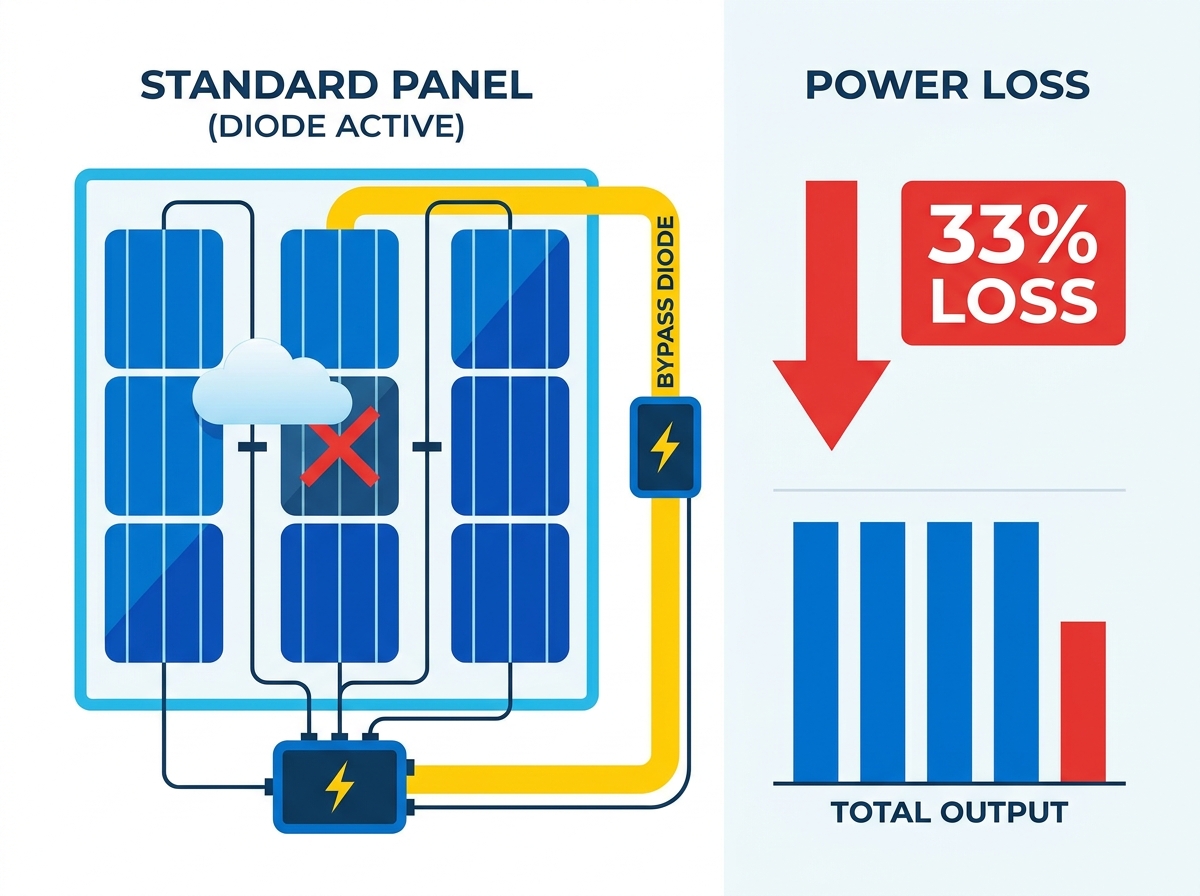
Activating a bypass diode sacrifices the power output of an entire cell string (typically 33% of a standard panel), severely dragging down total system efficiency.
Modern yield optimization requires evaluating Module-Level Power Electronics (MLPE) or dynamic MPPT algorithms, rather than relying on diodes alone.
Incorporating a bifacial solar panel strategy can alter the shading penalty by leveraging rear-side albedo capture, though it requires specific mounting clearance.
Selecting solar panels for commercial rooftops requires factoring O&M costs, as failing diodes are difficult to diagnose and expensive to replace at scale.
The Electrical Reality: How Bypass Diodes Actually Function
Start by examining the cell-string bottleneck inherent in conventional designs. Solar cells operate in a strict series-wired configuration. Electric current flows sequentially through each interconnected silicon wafer. If a single cell experiences shade, its internal electrical resistance increases rapidly. This sudden resistance acts exactly like a kinked water hose. It immediately bottlenecks the entire connected series string. You lose significant generation potential instantly.
To solve this dangerous bottleneck, manufacturers utilize bypass diodes. We must detail their precise mechanism of action. These small semiconductor components provide an alternate electrical path. They allow direct current to route around the shaded cell string entirely. This crucial diversion prevents reverse bias inside the shaded silicon cells. It keeps the unshaded portions of the array flowing freely.
However, system designers must clearly understand the safety versus yield trade-off. Manufacturers install these diodes primarily for thermal protection purposes. Shaded cells consume electrical power instead of generating it. They transform this absorbed power directly into extreme concentrated heat. This localized heat creates destructive physical hotspots. Severe hotspots cause glass shattering, backsheet melting, or even roof fires. Diodes prevent these extremely dangerous thermal runaway events. They sacrifice significant power generation to ensure basic operational safety. They act as vital protective shields. They are absolutely not efficiency boosters. Relying on them for daily yield optimization represents a fundamental design error.
Where Bypass Diodes Fail: Implementation Realities and Risks
Let us examine the dreaded 33% production cliff. Most standard full-cell modules contain exactly three internal bypass diodes. Each individual diode protects a specific third of the panel array. Shading just one single cell triggers its respective protective diode. This sudden activation drops 33% of the panel's total output instantly. You lose one-third of your production capacity over a single fallen leaf.
Next, consider the severe degradation and thermal fatigue risks. These small semiconductor components face harsh physical operational limitations. Frequent daily shading cycles force diodes to switch on and off repeatedly. Active diodes run extremely hot during standard operation. Constant extreme thermal cycling leads to premature hardware degradation inside the junction box. Over time, this unrelenting thermal fatigue causes complete component failure.
This degradation cycle creates a massive hidden O&M nightmare. Diode failure represents a critical operational risk for asset owners. When these components fail, they usually fail in a closed state. We call this a shorted diode condition. A shorted diode permanently reduces module output by 33%. These hidden failures remain notoriously difficult to spot visually during routine inspections. Maintenance teams must utilize specialized thermal imaging drones to locate them. Alternatively, technicians perform localized IV-curve tracing across the entire array. Commercial sites often feature thousands of interconnected modules. Finding one shorted diode among ten thousand panels resembles finding a needle in a haystack. Both diagnostic methods require expensive manual labor and specialized technical equipment.
Hardware vs. Algorithmic Mitigation: Evaluating Modern Solutions
Modern PV system design offers two primary performance optimization pathways. You can choose heavy hardware-based deployments or sophisticated software-led algorithmic approaches.
Module-Level Power Electronics (MLPE)
Optimizers and microinverters fundamentally alter system architecture. They move MPPT tracking directly to the individual panel level. They isolate the specific shading impact strictly to a single affected module. The rest of your unshaded string array remains entirely unaffected. Microinverters convert DC to AC directly at the panel. This eliminates high-voltage DC risks completely.
However, you must weigh the complex ROI consideration carefully. MLPE requires significantly higher upfront CAPEX during initial construction. You also introduce numerous electronic point-of-failure risks directly onto the hot roof. Replacing a failed roof-mounted microinverter requires dispatching a full truck roll. You must balance these high installation and replacement costs against projected long-term yield gains.
String Inverters with Dynamic MPPT (Software-Led)
Many modern string inverters utilize a highly effective software-led approach. They feature advanced algorithmic tracking designed specifically for shading events. Global maximum power point (GMPP) tracking algorithms scan the entire voltage range continuously. These sophisticated inverters periodically sweep the entire operational curve. They adjust system voltage to bypass shaded modules intelligently. This optimization happens entirely without requiring extra expensive per-panel hardware.
We strongly recommend using a specific evaluation lens here. Algorithmic tracking works exceptionally well for sites facing predictable, moving shade. Structural parapets and nearby buildings create these highly predictable shadow patterns. Conversely, it struggles against highly complex, scattered shading profiles like dense tree canopies.
Table 1: Shading Mitigation Technology Comparison
Technology Type
Primary Mechanism
Best Application Use Case
Relative Cost Profile
Bypass Diodes
Internal string bridging
Basic thermal safety protection
Included in standard panel cost
Dynamic MPPT
Software voltage sweeps
Predictable daily shadow lines
Low (Inverter standard feature)
MLPE (Optimizers)
Panel-level MPPT tracking
Complex, scattered roof shade
High (Requires extra hardware)
How a Bifacial Solar Panel Responds to Partial Shading
Advanced cell architectures offer another distinct layer of shade resilience. A properly installed bifacial solar panel captures reflected light on its rear side. We call this powerful phenomenon the albedo effect. Standard monofacial panels rely entirely on front-side irradiance. Bifacial modules utilize a transparent backsheet or dual-glass design. Sunlight bounces off the underlying roof surface constantly. The module's transparent rear glass absorbs this valuable scattered energy.
This continuous rear-side generation helps mitigate front-side shade impacts significantly. Diffuse rear-side light keeps the partially shaded front cells electrically active. They generate a small but steady amount of holding current. This extra induced current potentially delays the severe internal voltage drop. Consequently, it takes much heavier front shading to trigger the protective bypass diode.
However, you must strictly follow rigid installation prerequisites. This specific operational benefit remains highly conditional upon site geometry. Your design requires an appropriate mounting tilt to maximize rear exposure. You need highly reflective albedo roofing material situated beneath the array. White TPO membranes or light-colored gravel work perfectly for this purpose. You must aggressively avoid traditional flush-mount rooftop setups. Flush mounts block vital rear ambient light entirely. Without proper rear clearance, this architectural advantage becomes mathematically unviable.
System Design and Procurement for Commercial Rooftops
Proper commercial system design requires highly accurate scalability and risk assessment protocols. When selecting suitable solar panels for commercial rooftops, evaluate all surrounding structural obstacles closely. Rooftop obstacles create complex geometric challenges. Planners must calculate exact shadow lengths across all four seasons. Rooftop HVAC units cast harsh, irregular shadows continuously. Raised roof parapets create highly predictable daily shadow lines. Adjacent high-rise buildings cast massive, moving shade profiles across the array.
You must perform rigorous CAPEX versus lifetime OPEX modeling. Balance the exceedingly high initial cost of adding MLPE devices. Compare them directly against the lifetime OPEX of running standard panels. Standard panels suffer heavily from diode thermal fatigue over two decades. Truck rolls for diagnostic testing quickly consume your operational budget.
Always conduct thorough warranty and technical compliance checks. Review specific manufacturer warranties closely before signing procurement contracts. Look specifically for comprehensive diode replacement labor coverage. Some brands only provide free replacement hardware components. You end up paying for the expensive diagnostic and physical replacement labor. Check strictly for standard IEC thermal cycling test compliance.
Apply this simple, practical shortlisting logic for your commercial projects:
Low or Predictable Shade: Select standard high-efficiency modules. Pair them directly alongside a dynamic MPPT string inverter.
Heavy or Complex Shade: Specify MLPE devices immediately. Use dedicated optimizers or microinverters to isolate severe localized losses.
Reflective Flat Roofs: Deploy advanced bifacial modules. Utilize elevated structural racking to offset minor structural racking shading completely.
Conclusion
Bypass diodes represent an outdated crutch in modern commercial PV design. Treating them as a primary shading solution guarantees severe long-term underperformance. They excel purely at catastrophic fire prevention but fail miserably at yield optimization. They sacrifice entire sections of your array just to keep the system safe.
You must match your chosen mitigation strategy exactly to specific site conditions. Evaluate MLPE devices, advanced string inverters, and bifacial architecture objectively. Align these diverse technologies strictly with your long-term OPEX budget capabilities.
Your immediate next step requires highly detailed site performance modeling. We strongly recommend conducting a full 3D shading analysis immediately. Use trusted industry-standard software programs like PVSyst or HelioScope. Model your exact structural rooftop obstacles thoroughly before finalizing any hardware procurement list.
FAQ
Q: Do bypass diodes completely eliminate the negative effects of shade?
A: No. They prevent physical fire and severe hotspot risks. However, they achieve this safety by completely sacrificing the power output of the shaded section. You still lose massive generation capacity every time they activate.
Q: Can a failed bypass diode be repaired?
A: In most modern modules, manufacturers pot these diodes securely inside the junction box. They use hard sealant for maximum weatherproofing. A failure typically requires an RMA and a full module replacement. Simple field repairs remain physically impossible.
Q: Are optimizers always better than bypass diodes?
A: Optimizers manage complex shade far more efficiently than standard diodes. They isolate energy losses to individual panels. However, they introduce higher upfront costs. They also add more electronic components to your roof. You must justify these additions mathematically.
Q: Will a bifacial solar panel still trigger its bypass diodes?
A: Yes, severe direct shading will absolutely still trigger them. However, ambient rear-side light can significantly lower the electrical resistance of front-shaded cells. This unique architectural trait physically narrows the specific conditions under which the safety diode must activate.