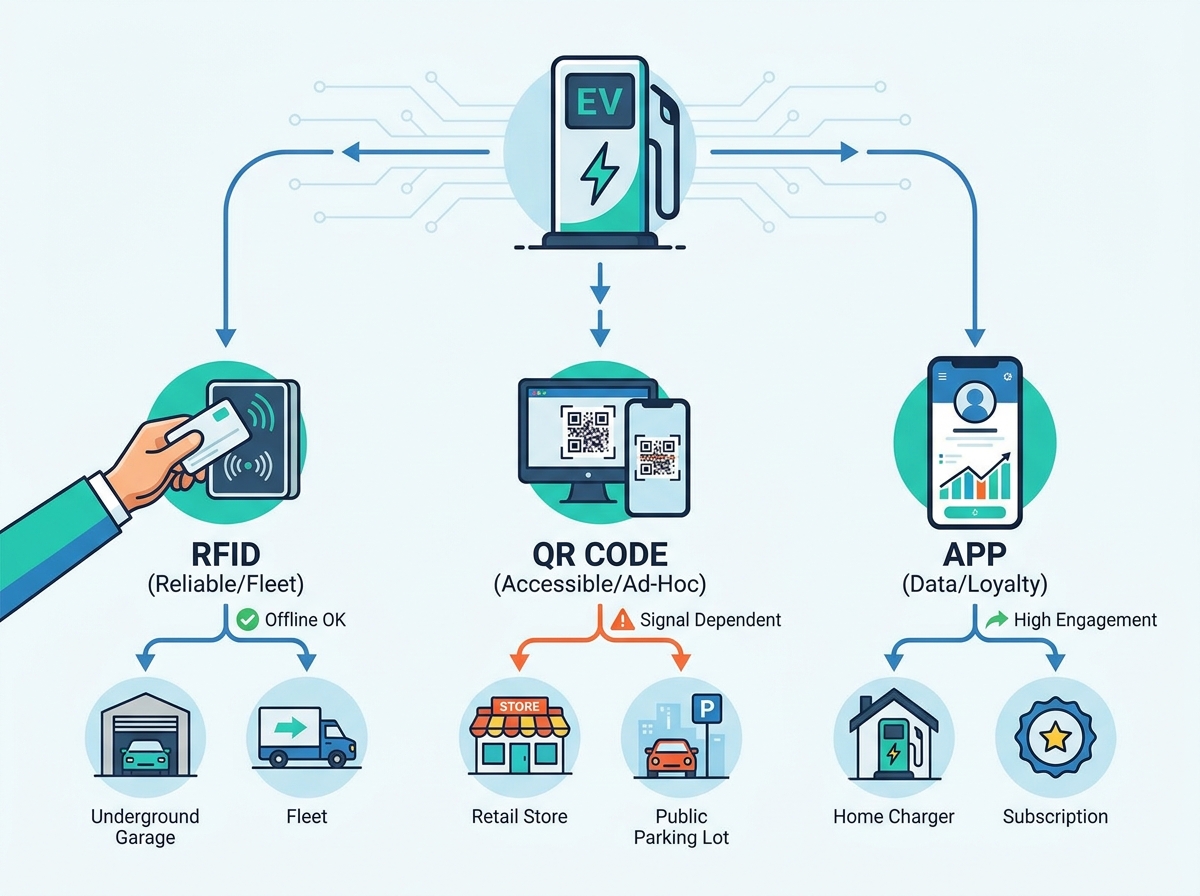
For Charge Point Operators (CPOs) and facility managers, the biggest barrier to a successful charging session rarely involves the hardware's power output—it is the friction of authorization and payment. Failed sessions frustrate drivers quickly. They generate negative reviews and severely strain your customer support resources. Drivers increasingly expect EV charging to mirror the simplicity of a traditional gas station. As the EV market matures, users demand seamless access. Meanwhile, operators require secure, scalable, and compliant revenue collection platforms. You cannot achieve profitable utilization rates if drivers struggle to initiate a charge.
Choosing between RFID, QR codes, and dedicated mobile applications requires careful planning. Deploying a hybrid approach helps balance hardware costs, user experience, and network reliability. Relying on a single gateway often leads to service bottlenecks. This guide breaks down the operational realities of each method. We explore how different technologies impact your daily operations. You will learn practical strategies to reduce driver friction while meeting emerging global regulatory standards.
Key Takeaways
Reliability vs. Accessibility: RFID remains the most reliable method for closed networks and fleets, while QR codes offer the lowest barrier to entry for one-time, ad-hoc users.
Vulnerability Considerations: QR codes are susceptible to physical tampering ("quishing"), whereas mobile apps suffer from user "app fatigue" and cellular dependency in dead zones.
Hardware Strategy: Specifying an EV charger with RFID option alongside alternative digital gateways ensures fallback authorization when network connectivity drops.
Compliance Driver: Emerging regulations (like NEVI in the US and AFIR in the EU) are pushing commercial charging solutions toward multi-modal payment acceptance, reducing reliance on closed-loop app ecosystems.
The Operational Impact of EV Charging Authorization
Failed authorization directly damages your bottom line. It leads to stranded drivers and immediate revenue loss. Industry data reveals payment failures account for a massive percentage of help desk calls. Resolving these tickets consumes valuable operational bandwidth. Operators must prioritize seamless access to maintain long-term profitability. If a charger physically works but blocks access digitally, the asset becomes useless.
Success Criteria for CPOs
Operators measure authorization success through specific technical benchmarks. You should aim for these performance targets across your network:
Sub-10-second session initiation to keep drivers moving efficiently.
High offline-authorization success rates to combat unpredictable network outages.
Transparent data handshakes using the Open Charge Point Protocol (OCPP).
Modern backend systems handle OCPP AuthorizeReq and AuthorizeConf messages. Fast message processing ensures drivers do not wait awkwardly beside their vehicles.
Compliance and Standardization
Compliance guidelines increasingly dictate your authorization strategy. Industry mandates now require open access for ad-hoc charging. Drivers must have options to pay without creating specialized user accounts. In the United States, the NEVI program enforces accessible contactless payment systems. Similarly, the European Union's AFIR regulation mandates card-based or simple digital payments. You can no longer force mandatory subscriptions on transient users. Adapting to these rules prevents costly regulatory penalties.
RFID Cards: The Standard for Reliability and Fleet Management
Radio Frequency Identification (RFID) remains a cornerstone of charging infrastructure. It works through low-frequency radio wave communication. A physical card or key fob interacts directly with the station's internal reader. The process takes mere fractions of a second. The hardware reads the unique identifier (UID) and cross-references it against an approved database.
Key Evaluation Dimensions
Let us examine the core advantages and drawbacks of this legacy technology.
Strengths: It provides instantaneous authorization. It operates seamlessly in cellular dead zones like underground parking garages. It serves as an ideal solution for corporate fleets, residential buildings, and closed-loop employee charging networks.
Weaknesses: Operators face logistical hurdles when issuing or replacing physical cards. The technology also lacks dynamic pricing communication. A user cannot see real-time cost adjustments on a simple piece of plastic.
Implementation Reality
You need robust fallback mechanisms in real-world environments. Deploying an EV charger with RFID option provides a critical hardware-level safety net. Broader software networks frequently experience high latency. Local white-listing allows known RFID tags to initiate charges entirely offline. The charger stores valid tag IDs in its local memory cache. Once connectivity restores, the system uploads the offline session data to your backend. We consider this localized authorization a vital best practice for high-uptime locations.
QR Codes and Web-Apps: Removing Barriers for Ad-Hoc Users
QR codes bridge the physical hardware gap and digital payment gateways. Users scan a physical code on the charger using their smartphone camera. This scan directs them to a mobile-optimized web payment interface. Drivers can quickly use Apple Pay, Google Pay, or direct credit card input. They skip the app store entirely.
Key Evaluation Dimensions
QR codes dramatically alter the user journey for transient visitors.
Strengths: They offer zero app-download friction. They excel in high-turnover public locations, retail centers, and tourist destinations. They carry a significantly lower upfront hardware cost compared to physical POS terminals.
Weaknesses: They rely entirely on the user’s cellular signal strength. They offer absolutely no offline capability. If a user has no data service, they cannot charge their vehicle.
Security Risks and Mitigation
You must acknowledge the rising threat of "quishing". Fraudsters place fake malicious QR stickers directly over legitimate ones. Unsuspecting drivers scan the fake code. They then enter payment details into a sophisticated phishing site. This fraud damages brand trust instantly.
Common Mistake: Relying solely on unmonitored printed stickers in public spaces invites tampering.
Best Practice: We strongly recommend using dynamic QR codes. Display them on digital LCD screens rather than relying on static printed stickers. Screens prevent physical sticker tampering. They also allow you to refresh the code for every unique charging session.
Dedicated Mobile Apps: Maximizing Data and Loyalty
Many network operators push drivers toward proprietary iOS and Android applications. These apps handle account management, station mapping, live availability, and session authorization. They create a dedicated ecosystem for the user. CPOs love apps because they capture direct user data.
Key Evaluation Dimensions
Apps provide rich telemetry but demand high commitment from the driver.
Strengths: They deliver deep telemetry, including live State of Charge (SOC) and charging curves. They enable recurring subscription models and robust loyalty programs. They facilitate seamless roaming integration across partner networks via protocols like OCPI (Open Charge Point Interface).
Weaknesses: They create immense user friction. Downloading an app, registering, and adding payment methods in the rain frustrates drivers. They also require significant ongoing software maintenance and update costs. "App fatigue" is real; drivers resent having ten different EV apps on their phones.
Implementation Reality
App-only strategies frequently result in poor user reviews. They also cause operators to lose transient ad-hoc revenue. You should position apps as a premium value-add for frequent users. Do not use them as the sole gateway to access electricity. Let casual users pay via web portals. You can reserve special app incentives, discounted rates, or reserved scheduling for loyal account holders.
Shortlisting Your Method for Commercial Charging Solutions
Selecting the right mix of authorization methods requires matching technology to your specific audience. You must analyze the primary use cases for your site. An apartment complex operates very differently from a highway rest stop.
Decision Matrix for Charging Methods
Use Case / Location
Primary Recommendation
Operational Rationale
Multi-Unit Dwellings (MUDs) & Workplaces
RFID + Mobile App
Known users charge daily. Offline reliability is crucial in thick concrete parking structures.
Retail Centers & Hospitality
QR (Web-App) + POS Terminals
Focuses on zero-friction, ad-hoc access for transient guests. Requires no app downloads.
Fleet Depots
RFID + Plug & Charge (ISO 15118)
Requires maximum security and automation. Zero driver intervention speeds up daily dispatch.
Future-proofing your infrastructure is vital for long-term success. You should standardize on commercial charging solutions natively supporting multi-modal inputs. Look for hardware featuring an integrated RFID reader, a digital screen for dynamic QR codes, and a robust OCPP backend for app connectivity. This comprehensive approach prevents expensive hardware retrofits later. It guarantees compliance with future open-access regulations and consumer protection laws.
Conclusion
No single authorization method universally outperforms the others. The optimal choice depends entirely on your site's primary user demographic. Local network conditions also play a massive role in hardware selection. You must avoid single-point-of-failure architectures. Relying solely on cloud-based apps courts disaster during network outages.
Pair physical credentials like RFID with digital flexibility like QR codes or apps. This diverse combination maximizes your station utilization rates. It guarantees high user satisfaction regardless of cellular connectivity or user technical proficiency.
Your immediate next action is to audit your site thoroughly. Test local cellular reception across your parking facility. Define your core user personas carefully. Complete these steps before finalizing any hardware procurement plans.
FAQ
Q: Can I retrofit an existing EV charger to accept QR code payments?
A: Yes, you can typically enable QR payments via CPO software updates. Your existing hardware must be fully OCPP-compliant. However, applying static QR stickers requires stringent security monitoring to prevent tampering and fraud. We suggest upgrading to dynamic screen-based codes whenever possible.
Q: Why do commercial EV chargers still use RFID in the age of smartphones?
A: RFID offers near-100% reliability and sub-second authorization speeds. Unlike smartphones, physical cards operate flawlessly in underground parking garages or remote locations where cellular data drops entirely. They provide an essential hardware-level fallback.
Q: What is the difference between an EV App and Plug & Charge?
A: Apps require manual session initiation by the driver. In contrast, Plug & Charge (ISO 15118) relies on digital certificates securely exchanged directly between the vehicle and the charger via the cable. It completely eliminates the need for apps, cards, or phones.