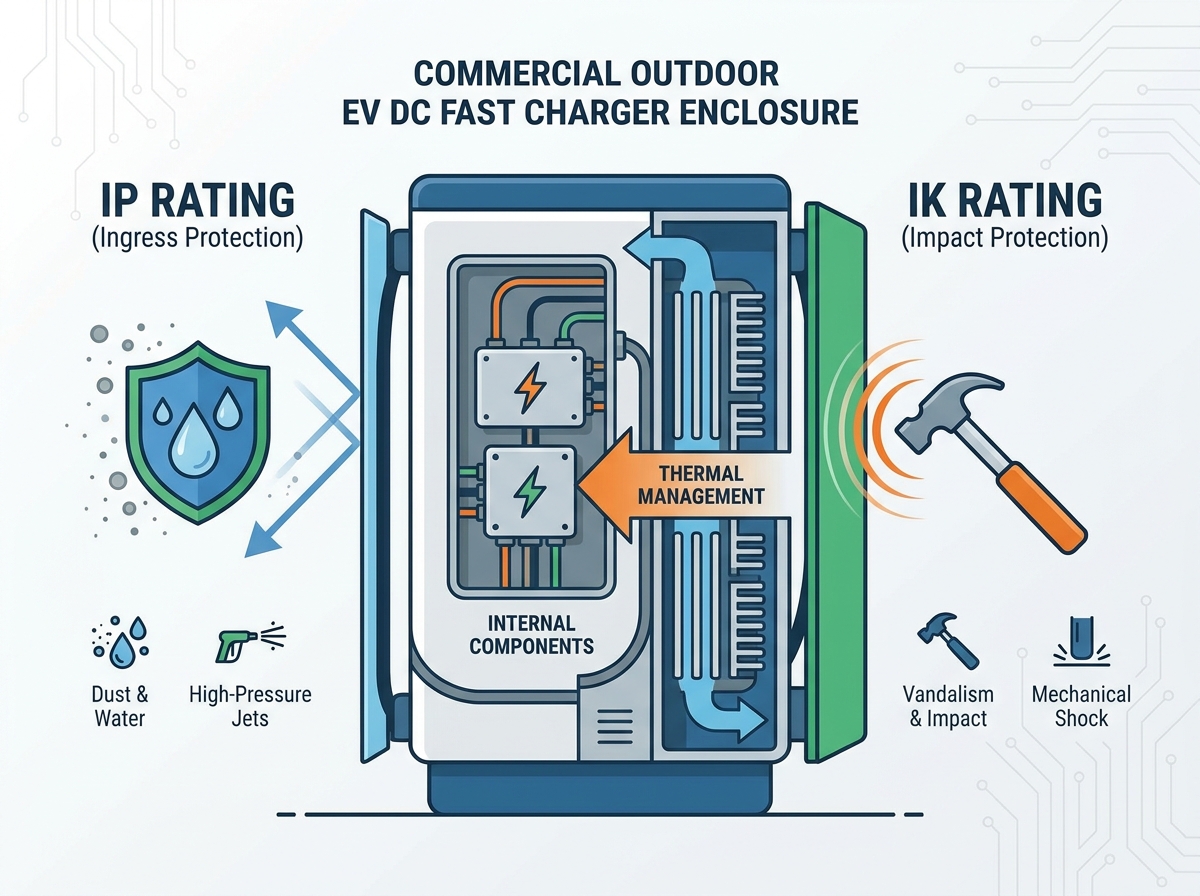
Investing in commercial charging infrastructure requires looking past glossy marketing specifications. You must understand the real-world durability and the actual survival rate of the hardware you plan to deploy. Unforgiving outdoor environments relentlessly expose your equipment to extreme weather, coastal salt spray, intentional vandalism, snowplows, and daily heavy-duty wear. Unprotected units degrade quickly, resulting in offline stations and frustrated drivers.
To protect your capital investments and guarantee high uptime, operators must critically evaluate IP (Ingress Protection) and IK (Impact Protection) ratings. Finding the right balance ensures you select resilient hardware tailored for specific deployment environments. In this guide, we will decode these vital protection metrics, explore essential hardware defenses, and help you confidently build a reliable charging infrastructure. You will learn how to bypass standard marketing fluff and select hardware designed for long-term survival.
Key Takeaways
IP and IK ratings are standardized international metrics for environmental and mechanical resistance, not arbitrary marketing buzzwords.
For a reliable outdoor DC charger, an enclosure rating between IP54 and IP65 is the baseline for commercial viability.
High IK ratings (IK08–IK10) are non-negotiable for public-facing or unattended sites to mitigate downtime caused by vandalism or accidental impacts.
The most resilient EV charger safety features balance high enclosure protection with advanced thermal management to prevent overheating.
The Business Case for Weather and Impact Resistance
Why Standard Enclosures Fail
Deploying minimally rated enclosures in commercial applications almost always leads to rapid hardware failure. Commercial sites expose units to harsh UV rays. This constant sun exposure degrades standard plastics, making them brittle over time. Moisture intrusion then creeps in through weakened seals. Once water reaches the internal power electronics, short circuits occur immediately. Physical abuse adds another layer of destruction. Drivers drop connectors, scrape cables, or bump enclosures. Without reinforced housings, these minor accidents quickly escalate into major structural failures.
The Financial Impact of Weak Hardware
Under-speccing outdoor hardware creates severe financial consequences for operators. You might save money on the initial purchase, but frequent maintenance roll-outs quickly consume those savings. Premature hardware replacement destroys your budget. Beyond direct repair costs, you face significant lost charging revenue due to unexpected downtime. Offline chargers frustrate drivers. They will simply drive to a competitor's location, taking their loyalty and money elsewhere.
Criteria for Operational Success
Achieving the industry-standard 97% or higher uptime requires careful planning. You must match the physical protection ratings of the charger to the absolute worst-case scenarios of the site. A sheltered depot presents different risks compared to an exposed coastal highway. By aligning environmental and mechanical resistance metrics to specific site realities, you protect your revenue streams and keep fleets moving reliably.
Decoding IP Ratings for an Outdoor DC Charger
First Digit: Defending Against Solids and Dust
The IP rating system uses two numbers to define environmental protection. The first digit measures defense against solid objects and dust. When evaluating an outdoor DC charger, a rating of '5' (Dust Protected) or '6' (Dust Tight) is mandatory. Roadside locations kick up massive amounts of debris. Agricultural and industrial sites expose equipment to fine particulates. If dust breaches the enclosure, it settles on sensitive circuit boards. This buildup traps heat and inevitably causes catastrophic electrical shorts.
Second Digit: Managing Liquids and Water
The second digit represents liquid ingress protection. You must understand the difference between standard rain protection (IPx4) and high-pressure water resistance (IPx5 or IPx6). An IPx4 rating handles splashing water, like normal rainfall. However, municipal sites often use street sweepers and pressure washers for cleaning. Maintenance crews accidentally spray chargers directly. An IPx5 rating ensures the unit survives these low-pressure water jets, while IPx6 handles powerful water streams without leaking.
The Implementation Reality Trap
Many operators fall into the trap of over-speccing their equipment. They assume a fully sealed IP67 unit is the ultimate solution. In reality, completely watertight enclosures struggle severely to manage internal condensation. They trap moisture inside as temperatures fluctuate between day and night. Furthermore, they severely restrict thermal management. For high-power applications, an IP54 or IP65 enclosure paired with proper internal drainage is often superior. It balances adequate weather defense while allowing the unit to breathe and cool down.
Understanding IK Ratings and Vandalism Defense
The IK Scale Explained
The IK rating system (IEC 62262) measures the degree of protection an enclosure provides against external mechanical impacts. Manufacturers translate IK ratings (ranging from 00 to 10) into real-world impact energy, measured in Joules. Testing involves dropping specific weights from defined heights directly onto the enclosure. This stress testing guarantees the metal or composite housing will not crack, dent, or fail under pressure.
Standard IK Protection Levels Overview
IK Rating
Impact Energy (Joules)
Real-World Equivalent Impact
IK07
2 Joules
A moderate accidental bump from a heavy hand tool.
IK08
5 Joules
A 1.7 kg steel mass dropped from 300 mm. Solid physical strike.
IK09
10 Joules
A forceful kick or heavy object thrown at the unit.
IK10
20 Joules
A 5 kg mass dropped from 400 mm. Severe vandalism attempts.
Choosing Between IK08 and IK10
Knowing when to mandate maximum impact resistance saves both capital and headaches. You should demand IK10 (20 Joules) for exposed, unattended public parking lots. These areas experience high rates of intentional vandalism and accidental vehicle strikes. Conversely, an IK08 rating (5 Joules) is typically sufficient for access-controlled fleet depots. Controlled environments present far lower risks of malicious damage, allowing you to optimize your hardware budget.
Addressing Vulnerability Gaps
Even the toughest enclosure cannot protect every single component. You must address failure points not covered by the primary enclosure IK rating. Touchscreen displays remain highly vulnerable to scratching and shattering. RFID readers fail if struck directly. Connector holsters and cable management retractor systems break under heavy pulling. Look for designs featuring recessed screens, protective overhangs, and reinforced cable management systems to cover these physical vulnerability gaps.
Balancing Ingress Protection with Thermal Management
The Inherent Airflow Conflict
Operators face a fundamental conflict when deploying fast chargers. High IP ratings inherently restrict airflow to keep out dust and water. Yet, fast chargers generate massive amounts of internal heat during peak load operations. Converting alternating current to direct current at high voltages produces immense thermal energy. If the enclosure cannot expel this heat, the system overheats and shuts down.
Evaluating Cooling Architectures
Top-tier manufacturers solve this thermal conflict through intelligent design. When evaluating hardware, pay attention to the cooling architecture. The best designs utilize isolated internal compartments. They seal the sensitive power electronics in an IP65 watertight compartment. Meanwhile, they leave the cooling channels and heavy heat sinks open to forced air or liquid cooling systems. This split design protects the delicate components while ensuring maximum heat dissipation.
Risk Mitigation in High-Dust Areas
You must actively avoid chargers relying on simple filter mats in high-dust environments. Standard air filters seem like a cost-effective solution initially. However, they quickly clog when exposed to dirt, pollen, and road debris. Once the filter blocks the airflow, the system experiences severe thermal throttling. Charging speeds drop drastically, and hardware faults trigger network alarms. Invest in sealed power modules requiring zero external air exchange for maximum reliability.
Essential EV Charger Safety Features Beyond the Enclosure
Critical Internal Safeguards
Physical durability only solves half the problem. You must pair strong metal housings with active, intelligent electrical protections. High-quality EV charger safety features include advanced ground fault detection to protect users from electrocution. Surge protection devices (SPDs) shield the mainboards from lightning strikes and grid voltage spikes. Continuous temperature monitoring at the connector pins prevents the cables from melting during long, high-power sessions.
Compliance and Verification
Never take a manufacturer's word at face value. You must verify compliance through recognized independent laboratories. Look for UL, CE, or regional equivalent certifications. These stamps of approval validate the safety claims listed on the datasheet. Independent testing guarantees the internal breakers trip correctly, the wiring handles the rated load, and the unit will not pose a fire risk in public spaces.
Software-Level Defense Mechanisms
Modern smart chargers employ software-level defenses to prevent catastrophic failures. They use real-time telemetry to monitor the health of the hardware constantly. Built-in tilt sensors detect physical impacts or vehicle collisions instantly. Moisture sensors alert operators if water breaches the seals. Network operators receive these alerts in real time. This allows you to dispatch maintenance teams before a minor issue causes permanent hardware destruction.
Framework for Shortlisting Commercial Charging Hardware
Step-by-Step Vendor Selection
Evaluating commercial hardware requires a structured, objective approach. Follow this framework to ensure you select the best possible equipment for your network.
Conduct Site Profiling: Map out your specific site requirements before issuing Requests for Proposals (RFPs). A covered logistics depot needs different hardware than a highly exposed, coastal public charging hub. Document the average rainfall, temperature extremes, and vandalism risks for each site.
Demand Evidence of Claims: Request third-party laboratory testing certificates for all IP and IK claims. Reject any undocumented manufacturer claims immediately. If they cannot provide an official IEC test report, cross them off your list.
Scrutinize Warranty Alignment: Read the vendor warranties carefully. Look for exact exclusions regarding environmental damage, acts of God, and vandalism. Ensure the hardware ratings align perfectly with the Service Level Agreement (SLA) terms. If the vendor claims IP65 but voids the warranty for water damage, find another partner.
Review Field Repairability: Check how easily maintenance teams can swap out components. Modular designs allow technicians to replace a broken screen or damaged cable in minutes instead of hauling the entire unit back to a repair facility.
Conclusion
Selecting commercial charging infrastructure is a complex decision. You must weigh the upfront cost of highly rated hardware against the devastating operational costs of failing infrastructure. Buying cheap enclosures inevitably leads to offline stations, furious customers, and endless repair bills. Robust environmental protection guarantees your network stays active and profitable.
Prioritize manufacturers prioritizing transparency. They should gladly provide verified lab certificates for their IP and IK ratings. Choose vendors utilizing smart thermal management strategies and modular field repair designs. These features keep your operational efficiency high and maintenance visits brief.
Your next step requires immediate action. Conduct a thorough environmental and physical risk audit of your proposed installation sites. Establish your baseline IP and IK requirements clearly before engaging any vendors or signing purchasing contracts.
FAQ
Q: What is the minimum IP rating for an outdoor DC charger?
A: IP54 is the absolute minimum standard for outdoor use. However, IP65 is strongly recommended for sites exposed to heavy rain, blowing dust, or coastal salt environments to ensure long-term reliability.
Q: Does an IK10 rating make the charging screen unbreakable?
A: No. The IK10 rating typically applies only to the main metal or composite enclosure. Touchscreens and glass components usually carry a lower, separate rating. Always look for units featuring recessed screens or protective overhangs.
Q: Can an EV charger be completely waterproof (IP67/IP68)?
A: While technically possible, it is highly impractical for fast chargers. Fully waterproof enclosures prevent the necessary heat dissipation required for high-voltage power conversion, leading to severe thermal throttling and shutdown.
Q: Do high IP and IK ratings prevent warranty claim denials?
A: They significantly reduce the likelihood of a manufacturer citing improper environmental deployment to deny a claim. Operators must still read the fine print regarding intentional vandalism or extreme weather anomalies.