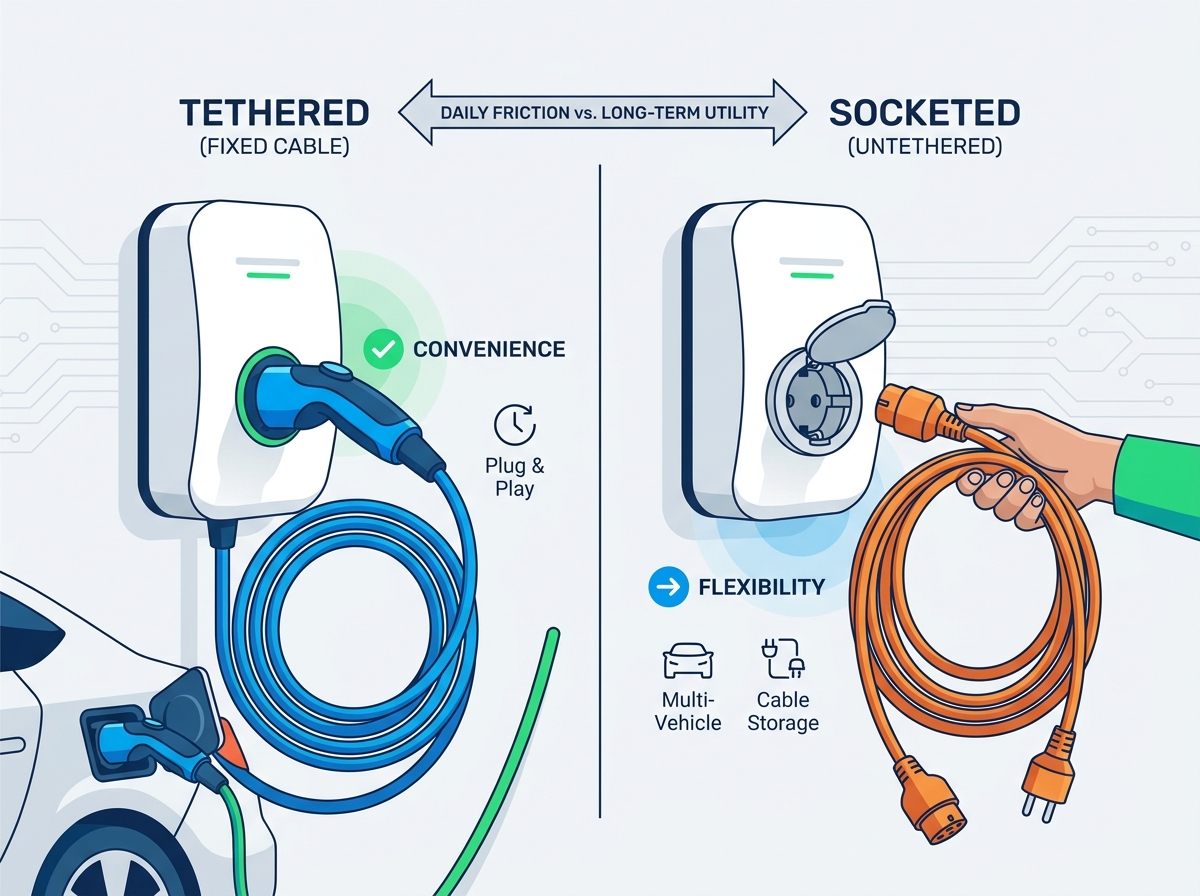
You finally decided to upgrade your daily commute to electric. You selected the perfect vehicle and found a reputable installer for your home or business. Now you face one crucial hardware decision before the installation begins. Do you want the charging cable permanently attached or kept separate? This choice goes far beyond simple wall aesthetics. It directly impacts your daily charging friction, hardware lifespan, maintenance risks, and cross-vehicle compatibility. A bad choice here can lead to frustrating daily routines or unexpected repair bills down the road. Keep in mind, there is no single universal solution for everyone. We will help you find the optimal configuration based on specific site security, weather exposure, and personal usage habits. Read on to discover which setup perfectly matches your unique parking environment and fleet needs.
Key Takeaways
Convenience vs. Clutter: Tethered units offer "plug-and-play" daily readiness but can appear messy; socketed units provide a minimalist wall footprint.
Maintenance Realities: A damaged tethered cable often requires professional repair, whereas a socketed setup isolates cable damage to a swappable, consumable part.
Future-Proofing: Socketed chargers accommodate multiple EV connector types (Type 1 and Type 2), making them ideal for multi-EV households or commercial applications.
Site Security: Exposed, public-facing installations favor socketed units to deter copper theft and vandalism.
Baseline Configurations for an AC EV Charging Station
When planning your site setup, you must understand the two primary hardware paths available. Every modern AC EV charging station falls into one of two physical categories. You can choose a fixed cable or opt for a separate cable connection. Understanding the fundamental operational assumptions behind each type will guide your initial decision-making process.
The Tethered Approach (Fixed Cable)
A tethered unit features a charging cable permanently hardwired into the wallbox housing. You cannot detach it from the main unit without dismantling the internal wiring. This setup operates on a few specific assumptions. It assumes you rely on a single, fixed connector standard for your vehicle. It also assumes you prioritize immediate access over hardware flexibility. You simply pull your vehicle up, unspool the cord from the wall, and plug it directly into your car. There is no need to dig into your trunk.
Common Mistake: Many new EV owners assume they can simply swap a hardwired cable themselves if they buy a different vehicle later. This is incorrect. Altering a hardwired cable requires a certified electrician and often voids the manufacturer warranty.
The Socketed Approach (Untethered / BYO Cable)
A socketed unit features a universal female socket built directly into the wallbox. You must plug in a separate, dual-ended cable to initiate a charge. This approach assumes you highly value aesthetic minimalism on your property. It also appeals to users who demand cross-vehicle compatibility. Furthermore, it assumes you expect high hardware wear and tear. You bring your own cable to bridge the gap between the wall unit and the vehicle port.
Best Practice: Always keep your separate charging lead coiled neatly in a designated trunk bag. This prevents the heavy connector pins from scratching your interior plastics during transit.
Core Evaluation Dimensions for a 7kW AC Charger
Choosing between these two distinct setups requires balancing your daily habits against long-term hardware realities. Let us break down exactly how a standard 7kW AC charger performs under both configurations. We will evaluate time, aesthetics, longevity, and future compatibility.
Daily Friction vs. Visual Impact
You must evaluate the true time-cost of your daily routine. A tethered setup saves you roughly 30 to 60 seconds every single day. This adds up over years of ownership. You completely eliminate the need to unpack a wet, dirty, or frozen cable from your vehicle trunk on dark winter mornings. The convenience is unmatched.
However, you must also evaluate the aesthetic impact on your property. Socketed units look significantly cleaner when they are not in use. They present a flat, minimalist profile on your wall. Tethered units often suffer from the "garden hose" effect. A poorly spooled, thick black cable hanging loosely on a pristine white garage wall can look messy and unappealing.
Asset Longevity and Maintenance Risks
You face specific maintenance risks whenever you rely on a hardwired cable. Accidents happen frequently in busy driveways. If you drop the plug onto hard concrete, drive over the connector, or expose it to severe weather, the hardware degrades. Repairing a damaged hardwired cable is rarely a DIY job. It usually triggers a hefty callout fee for a certified electrician. In worst-case scenarios, you must pay for a full unit replacement.
Socketed units offer a distinct and highly practical advantage here. The separate cable acts as an easily replaceable consumable item. If the pins bend or the rubber cracks, you simply purchase a new standalone cable online. You incur absolutely zero installation costs. You just plug the new lead into the socket and resume charging.
Cross-Compatibility and Future-Proofing
You should carefully assess your current fleet and future vehicle plans. Tethered units lock your site into a specific factory connector. If you currently drive a vehicle with a specific port but plan to buy a different brand next year, you might face strict compatibility roadblocks.
Socketed setups provide immense flexibility for changing fleets. You can charge older Type 1 vehicles on Monday and modern Type 2 vehicles on Tuesday. You achieve this simply by swapping the external cable. The wallbox itself remains a universal hub.
Feature Comparison Summary
Evaluation Dimension
Tethered Configuration
Socketed Configuration
Daily Convenience
High (Plug-and-play immediately)
Moderate (Requires unpacking cable)
Visual Appearance
Prone to clutter if poorly spooled
Clean, minimalist wall profile
Maintenance Risk
High (Requires electrician to fix)
Low (User can swap damaged cable)
Vehicle Compatibility
Locked to one connector type
Universal (Adapts via separate cable)
Implementation Realities: Security and Site Management
Physical security and ongoing environmental exposure heavily dictate how your hardware survives over time. You must evaluate your specific parking environment honestly before making a purchase. Ignoring these environmental realities leads to premature hardware failure.
Theft and Vandalism Vulnerabilities
You will find common concerns regarding exposed installations on popular EV user forums. Hardwired cables installed on exposed driveways or unsecured commercial lots are occasionally targeted for copper theft. Thieves can quickly snip the thick external cables in the middle of the night. This leaves you with an unusable charger and an expensive repair bill.
You can mitigate this risk effectively by choosing the right hardware. Socketed stations allow you to unplug the valuable cable entirely. You can lock it securely in your vehicle trunk or store it inside your home when it is not in use. A bare wallbox socket offers zero value to copper thieves.
Weather Exposure and Cable Degradation
You must analyze the environmental impact on your charging equipment. Tethered cables endure 24/7 ultraviolet exposure, heavy frost, and driving rain. These relentless natural elements accelerate the degradation of the outer rubber jacket. Over time, the material becomes brittle and prone to dangerous cracking.
If you choose a tethered unit for an outdoor location, you require strict design considerations. You must demand strict adherence to proper mounting heights. You must also install specialized plug holsters. These precautions prevent the sensitive plug heads from resting in muddy puddles, wet leaves, or deep snowbanks.
Decision Matrix: Matching Setup to Site Profile
Your final decision relies heavily on where you park your vehicle. We can simplify this complex choice by grouping environments into two primary site profiles. Review these profiles to see which one matches your daily reality.
Private Residential Garages and Secure Driveways
Our primary recommendation for this specific environment is a tethered setup.
A controlled, indoor, or heavily monitored environment largely removes theft and vandalism risks. You park in a safe, predictable spot every single day. In this scenario, the sheer daily convenience heavily outweighs any desire for aesthetic minimalism. You pull in, grab the waiting handle, and plug in within seconds. You avoid the dirty task of wrestling with a separate cable inside your clean garage.
Best Practice: Even in a garage, install a wall-mounted cable hook. Draping the cable over the unit itself can damage the internal casing over time.
Shared Residential, Flats, and Commercial Parking
Our primary recommendation for these highly exposed or communal areas is a socketed setup.
This configuration easily accommodates diverse visitor EVs with different charging ports. It effectively prevents costly hardware replacements caused by careless public usage. More importantly, it dramatically mitigates theft in unsecured environments. Visitors or residents simply supply their own leads. The property owner only maintains the durable, impact-resistant wall socket.
Shortlisting and Finalizing Your Setup
You need to check a few final details before booking your installation date. These practical steps ensure a smooth, frustration-free charging experience for years to come. Do not skip these physical checks.
Assess Cable Length Requirements
You must measure carefully if leaning toward a tethered unit. Strictly measure the distance from the proposed wallbox location to your EV charge port. Do not guess this crucial distance. You must account for slack, walking around the vehicle, and potential parking angle changes.
Measure the straight-line distance.
Add 1.5 meters for draping and slack.
Decide between a standard 5-meter cable or an extended 7-meter option based on your math.
A fixed cable that is too short will cause immense daily frustration and force awkward parking maneuvers.
Verify Cable Storage Solutions
You should check your vehicle storage capacity if leaning toward a socketed unit. Confirm your vehicle has adequate, easily accessible trunk space. A front trunk, commonly known as a "frunk," is absolutely perfect for daily cable storage. You want to ensure retrieving the cable does not require unpacking heavy groceries or moving child strollers every evening.
Check Smart Feature Overlap
You do not need to worry about software limitations based on your physical cable choice. Ensure your chosen configuration does not limit desired software features. Both hardware types generally support identical smart capabilities inside the main processor. You can still enjoy advanced solar integration or complex tariff scheduling regardless of whether your plug is fixed or separate.
Conclusion
You now understand the core decision logic behind AC charging setups. Choose a tethered configuration for highly secure, single-standard convenience. It works exceptionally well inside locked garages or safe private driveways where speed matters most. Choose a socketed unit for exposed sites, multi-EV compatibility, and lower long-term maintenance risks. It keeps your property looking clean and deters opportunistic copper thieves. We prompt you to evaluate your specific parking environment carefully. Observe your daily routine, measure your distances, and check your vehicle storage space before engaging an installer. Taking the time to match the hardware to your lifestyle guarantees a frictionless electric driving experience.
FAQ
Q: Can I convert a tethered charger to a socketed one later?
A: Generally no. Hardwired units are factory-sealed. Require a complete unit replacement or a technically complex, warranty-voiding retrofit.
Q: Are socketed EV chargers cheaper to install?
A: The wallbox itself is often marginally cheaper, but the total cost balances out once you purchase the required standalone charging cable. Installation labor remains identical.
Q: Do I need to buy a specific cable for a 7kW AC charger?
A: Yes, if using a socketed unit, you must ensure the standalone cable is rated for at least 32 amps / 7kW to achieve maximum charging speeds safely.