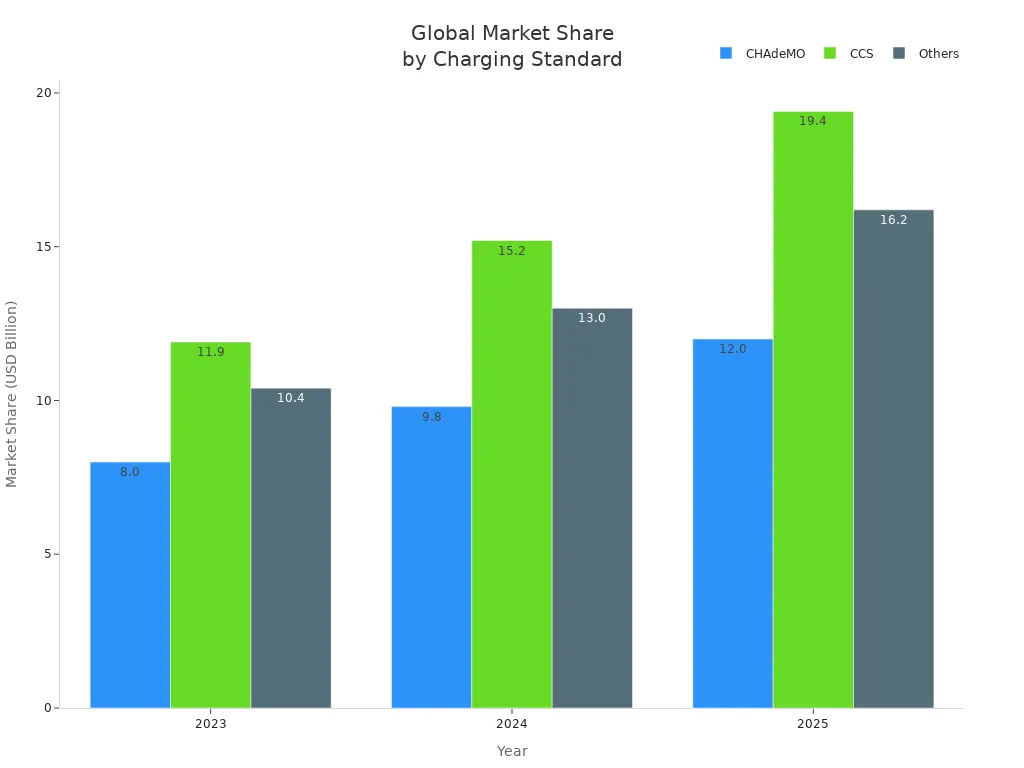
If you want the best choice in EV charging standards for most users, CCS stands out. You see this standard in many new EV models because it offers fast charging and works in North America and Europe. Charging speed matters when you need to get back on the road quickly. Regional adoption also plays a big role. For example, GB/T leads in China and CHAdeMO is common in Japan. The chart below shows how CCS leads in global market share from 2023 to 2025.
You should choose a standard that matches your location, your car, and your need for speed at the plug.
Key Takeaways
CCS is a great choice for most people. It charges fast and is easy to find in North America and Europe.
CHAdeMO is mostly used in Japan. It works well for older electric cars. There are not many stations outside Japan.
GB/T is the main standard in China. It works with many cars and charges fast at most places.
Always look at your car's plug type before you travel. This helps you avoid problems at charging stations.
Picking a car with a common charging standard like CCS makes charging easier. It also helps you feel less worried.
Quick Comparison of EV Charging Standards
Key Differences
When you look at electric car charging, you see three main standards. These are CCS, CHAdeMO, and GB/T. Each one has its own plug shape, speed, and place where it is used most.
CCS has one plug for both AC and DC charging. This is simple because you do not need to change plugs. You find CCS in Europe and North America. It charges cars fast and works with many new electric cars.
CHAdeMO has a different plug just for DC charging. You see this mostly in Japan. Some older cars in other places use CHAdeMO too. It charges fast, but there are not as many stations outside Japan.
GB/T is the main standard in China. It has two plugs, one for AC and one for DC. GB/T gives steady and strong power. If you drive in China, you will use GB/T at most charging spots.
Tip: Always look at your car’s plug before a long trip. This helps you not have trouble at charging spots.
When you check charging speeds, you see some changes. CCS1 can give up to 360 kW. CCS2 can go up to 350 kW. CHAdeMO can reach 400 kW with the newest version, but most stations are slower. GB/T can go up to 250 kW, which is fast for most people.
You also see that each place likes a different plug. Europe uses CCS2 at most public chargers. China uses GB/T. Japan uses CHAdeMO, mostly for older cars. North America is starting to use NACS, but CCS1 is still easy to find.
Comparison Table
Here is a table that shows the main ways CCS, CHAdeMO, and GB/T are different:
Standard
Connector Design
Communication Protocols
Charging Capabilities
Max Power Output
Main Regions
CCS
Single connector for AC and DC charging
High-speed communication
Versatile, supports both AC and DC
CCS1: 360 kW CCS2: 350 kW
Europe, North America
CHAdeMO
Separate connector for DC charging only
CAN protocol
Fast DC charging
Up to 400 kW
Japan
GB/T
Separate connectors for AC and DC
Similar to CHAdeMO
High stability and efficient power transfer
Up to 250 kW
China
You can see the top charging speeds in this list:
CCS1: Up to 360 kW (most times 50–150 kW)
CCS2: Up to 350 kW (often 50–350 kW)
CHAdeMO: Up to 400 kW (with CHAdeMO 2.0)
GB/T: Up to 250 kW
If you travel in Europe, you will use CCS2 most of the time. In China, you will see GB/T everywhere. Japan uses CHAdeMO, mostly for older cars. North America is changing, but CCS1 is still used a lot.
Note: The best charging standard for you depends on your car and where you drive. Always check your car’s book for the right plug.
Why EV Charging Standards Matter
Impact on Charging Experience
You see a big difference when your car uses the right charging standard. It helps you charge faster and get back on the road sooner. In the United States, people like fast charging. J1772 and CCS are popular because they are quick and easy to use. If you find a station with your plug, you save time, especially on long drives. DC Fast Charging is the fastest, but not all stations have every plug. If your car’s plug does not match, you might need an adapter. Sometimes you cannot charge at all. This can make you upset and waste your time.
Moving to one standard, like the North American Charging Standard, makes things easier. When more stations use the same plug, it is simpler to find a charger that works. This means less confusion and a better charging experience. Having one system also helps build more charging stations in more places.
Importance for EV Owners
If your car does not use the most common plug, you can have problems. You might get to a station and find out your plug does not fit. This can make you stressed and stop you from going far. Here are some problems you might have:
Not every charging station works with all cars.
Different plugs and standards can keep you from charging.
Picking a car with a common plug, like CCS, gives you more choices. You can charge faster and worry less about finding a place to plug in. This makes owning an electric car simpler and more fun.
CCS Overview
CCS Key Features
You will notice that ccs stands for Combined Charging System. This system uses one connector for both AC and DC charging. You do not need to switch plugs when you want to charge your vehicle at home or at a public fast charger. Many new electric cars use ccs because it is simple and works in many places. You can also find CCS chargers at most public stations in North America and Europe. The design supports both slow and fast charging, which gives you more flexibility.
CCS Power Output
When you use CCS chargers, you get a wide range of power. Some DC fast chargers deliver between 60 kW and 250 kW or more. This means you can charge your battery to 80% in just 20 to 40 minutes. Here is a table that shows how power output affects charging time:
Power Output (kW)
Estimated BEV Charge Time from Empty
1 kW
40 - 50 hours
7 kW - 19 kW
4 - 10 hours
50 - 350 kW
20 minutes - 1 hour
You can see that higher power output means less waiting at the charger. Most CCSs chargers can output between 50 kW and 350 kW, so you spend less time charging and more time driving.
CCS Compatible Vehicles
You will find that most new electric vehicles in Europe and North America use ccs. This includes popular brands like BMW, Volkswagen, Ford, and Hyundai. If you drive one of these vehicles, you will have many options for charging. You do not need to worry about finding a compatible station.
CCS Pros and Cons
Here is a quick look at the main advantages and disadvantages of CCS:
Advantages
Disadvantages
Integrated Design
High Initial Investment
Efficient Charging
Complexity of Connector Design
Universal Compatibility
Cost-Effective
Global Presence
Bidirectional Charging
Tip: If you want fast and easy charging, CCS gives you the best mix of speed and compatibility.
CHAdeMO Overview
CHAdeMO Features
CHAdeMO means "CHArge de MOve." This standard started in Japan. The chademo association made it. You use CHAdeMO for easy and safe charging. It has a special connector for DC fast charging. You see CHAdeMO at many public stations in Japan. The plug is simple to use. You just connect it and start charging. You do not mix up AC and DC plugs. CHAdeMO lets you send power from your car back to the grid or your house.
Tip: If you have an older Japanese electric car, you likely use CHAdeMO for fast charging.
CHAdeMO Power Output
CHAdeMO chargers give different power levels. Most stations today give up to 100 kW. Some new ones may reach 400 kW soon. This means charging will get faster as tech gets better. Here is a table that shows how CHAdeMO compares to other standards:
Standard
Max Power Output
CHAdeMO
Up to 100 kW (future 400 kW)
CCS
Up to 350 kW
GB/T
Up to 250 kW
You can see CHAdeMO is getting faster, but CCS is still the fastest.
CHAdeMO Compatible Vehicles
Many Japanese electric cars use CHAdeMO. Nissan Leaf and Mitsubishi Outlander PHEV use it. Some old Kia and Peugeot cars also use CHAdeMO. If you have one of these cars, you need to find CHAdeMO stations. Most new cars in Europe and North America use other plugs. But CHAdeMO is still important for many drivers.
CHAdeMO Pros and Cons
You should know the good and bad things about CHAdeMO before you pick a charging system.
Pros
Cons
Easy and safe connector
Not many stations outside Japan
Can send power back to grid
Lower power at most stations
Good for older cars
Not used in most new cars
Note: CHAdeMO is best if you drive a Japanese electric car or want to send power back to your home.
GB/T Overview
GB/T Features
You will see the GB/T standard almost everywhere in China. This system uses two types of connectors. One connector is for AC charging, and the other is for DC fast charging. You can find GB/T at most public charging stations in China. The design is simple and easy to use. You just plug in your vehicle and start charging. Most stations use clear labels, so you will not get confused. The GB/T standard helps you charge safely and quickly.
Note: Every electric vehicle sold in China supports the GB/T standard. This means you do not have to worry about compatibility.
GB/T Power Output
You can find a wide range of power outputs with GB/T chargers. Here are some key points:
The maximum power output of GB/T chargers ranges from 15 kW to 350 kW.
Some new megawatt stations are under development, aiming for 1000 kW.
Higher power output means faster charging, but your vehicle’s acceptance rate will limit the actual speed.
Most drivers in China use GB/T chargers for daily charging and long trips. You can expect fast charging at many stations, especially in big cities.
GB/T Compatible Vehicles
You will notice that almost all electric vehicles in China use GB/T. This makes it easy for you to find a charging station. The table below shows the market share for each charging standard in China:
Feature
GB/T Standard
CCS2
CHAdeMO
China Market Share
95%
<5%
<1%
You can see that GB/T covers almost the entire market. If you drive in China, your vehicle will use this standard.
GB/T Pros and Cons
You should know the main advantages and disadvantages of GB/T before you choose a charging system.
Pros
Cons
Very high compatibility across China
Limited use outside China
Wide range of charging speeds
Some older stations offer lower charging speeds
Simple connector design
Tip: If you plan to drive or buy an electric vehicle in China, GB/T gives you the best chance for easy and fast charging.
Plug Design & Infrastructure
Connector Differences
Each electric car charging standard has its own connector. These connectors look different from each other. You cannot use them without an adapter. Here are some main differences:
CCS connectors let you charge with AC or DC using one plug. This makes it simple to use the same port at home or at a fast charger. CCS2, which is common in Europe, has a smaller socket than other types.
CHAdeMO uses a special connector just for DC charging. You need another port if you want to use AC charging. The CHAdeMO plug is bigger and feels heavier when you hold it.
GB/T is the main standard in China. It uses two connectors, one for AC and one for DC charging. The design is easy, but you must pick the right port.
You cannot use a CCS plug at a GB/T station or the other way around. The way they talk to the car and the power they use are not the same. Safety features are also different. You need the right connector for your car and where you live. If you go to another country, you might need an adapter or a different car.
Tip: Always look at your car’s connector before a long trip. This helps you not have trouble at charging stations.
Charging Station Availability
Where you live and your car’s standard decide how many charging stations you find. In Europe and North America, CCS stations are at most public places. These stations let you charge fast or slow. In Japan, CHAdeMO stations are easy to find, especially for older cars. China has the most GB/T stations, so it is easy to charge there.
Here is a table to help you compare how many stations there are:
Standard
Main Regions
Charging Station Availability
CCS
Europe, North America
Very high in cities and highways
CHAdeMO
Japan
High in Japan, limited elsewhere
GB/T
China
Extremely high in urban and rural areas
You will see more charging stations where one standard is used the most. This makes it easier to plan trips and wait less at busy stations.
Regional Adoption & Market Trends
Global Usage
Different places use different charging standards. In Europe and North America, CCS is the most popular. Most new public stations use CCS connectors. You also see CCS on many new electric vehicles. In China, GB/T is the main standard because it fits the country’s rules. Japan still uses CHAdeMO, mostly for older cars. Some chargers in Japan can work with more than one plug type.
Here is a table that shows how market share trends have changed:
Charging Standard
Market Share Trend
Notes
CCS
Increased
Outnumbered CHAdeMO in the U.S.
CHAdeMO
Steady Growth
Many current EVs still use it
GB/T
N/A
N/A
Note: Multi-standard chargers help CHAdeMO stay useful in older markets.
Market Shifts
There is a big change in the U.S. market now. CCS charging spots are more common than CHAdeMO. This means more drivers and car makers like CCS. CHAdeMO is still growing because many cars still need it. In China, GB/T is the top choice since all electric cars use it. You also see more chargers that work with many plug types. These chargers help both old and new cars charge easily.
CCS connectors are now picked by big brands like Ford and Daimler AG.
GB/T connectors lead in China because of the country’s rules.
CHAdeMO grows fastest in Asia as fast charging spreads.
Future Outlook
You will see even bigger changes in the next ten years. Experts think GB/T will have about 60% of the world market by 2026. This is because China uses it so much. CCS will keep getting more popular as more car companies use it. CHAdeMO will grow the fastest, mostly in Asia, as more people want fast charging.
GB/T could reach 60% market share by 2026.
CCS will keep growing with help from big car companies.
CHAdeMO will grow quickly as fast charging gets more popular.
As more charging stations are built, you can travel farther and charge faster. The future looks good for all three standards. Your best choice depends on where you live and what car you drive.
Choosing the Right EV Charging Standard
Factors to Consider
When you pick an EV charging standard, you should think about a few key things. The right choice makes charging your car simple and helps you avoid trouble. Here are the main things to keep in mind:
Regional Compatibility: Different places use different standards. CCS is found in Europe and North America. CHAdeMO is used a lot in Japan. GB/T is what you see in China.
Vehicle Type: The kind of car you have is important. Plug-in hybrids and battery electric vehicles might need different plugs.
Charging Speed: Some plugs let you charge faster. If you want quick charging, check what your car and the station can do.
Interface Compatibility: Make sure the plug fits your car’s port. The shape and how it connects to your car must match.
Infrastructure Availability: Check how many stations use your plug in your area. More stations make charging easier.
Tip: Always look in your car’s manual to find out which plug you need before you go on a trip.
Conclusion
You need a charging standard that works in many places. It should charge your car quickly. CCS is the best for most people. It works with lots of cars and charges fast. Big car companies like Ford, GM, Volkswagen, and BMW use CCS.
Here are some tips when picking an EV:
Choose a car that can charge fast.
Bring a portable charger and an extra cable.
Find out which connectors are used near you.
Make sure your car and your area match for easy charging.
FAQ
What happens if you try to use the wrong charging plug?
You cannot charge your car if the plug does not fit. Charging stations use different shapes and systems. Always check your car’s manual before you travel.
Can you use adapters to charge with a different standard?
Some adapters exist, but not all work safely. You should use the plug made for your car. Using the wrong adapter can damage your car or the charger.
Which charging standard gives you the fastest charging?
CCS usually gives you the fastest charging speeds. Some CCS chargers reach up to 350 kW. CHAdeMO and GB/T are fast, but most stations offer lower speeds.
Will charging standards change in the future?
You will see changes as new technology comes out. More countries may switch to CCS or other new standards. Always check for updates when you buy a new electric car.