Expanding DC Fast Charging infrastructure requires careful planning and foresight. You must balance high capital expenditures against strict site constraints. Future scaling demands also shape these early layout decisions. Operators face a core conflict today. Should they choose self-contained units or decentralized architectures? This fundamental choice alters site design and initial installation expenses. It also heavily impacts long-term maintenance workflows. Real estate limitations dictate many of these engineering decisions. A small footprint heavily favors certain hardware solutions. A sprawling parking lot opens up entirely different possibilities.
This article provides operators, fleet managers, and site hosts a structured evaluation framework. You will learn how to choose the right hardware setup. We will explore footprint limitations and dynamic power requirements. We also guide you through long-term project viability constraints. By the end, you will understand exactly which architecture suits your specific commercial deployment. You can then confidently release accurate hardware procurement requests.
Key Takeaways
Architecture dictates scalability: An integrated DC fast charger is ideal for small footprint, low-stall deployments, while a split architecture excels in high-density EV charging hubs.
Space and noise matter: Split systems separate heavy, noisy power electronics from the user-facing dispenser, enabling ADA-compliant layouts in tight retail spaces.
Dynamic power sharing: Centralized power cabinets in split systems allow for more efficient, flexible power routing to multiple dispensers simultaneously.
Installation economics shift at scale: While initial trenching costs can be higher for split systems, the per-port scaling cost drops significantly as the site expands.
Understanding DC Fast Charging Architectures
Clarifying the physical and technical distinctions between hardware configurations builds a solid foundation. Operators often confuse terminology when browsing vendor catalogs. We must separate the physical user interface from the heavy power electronics. This separation dictates every subsequent engineering decision for your project.
The Mechanics of an Integrated DC Fast Charger
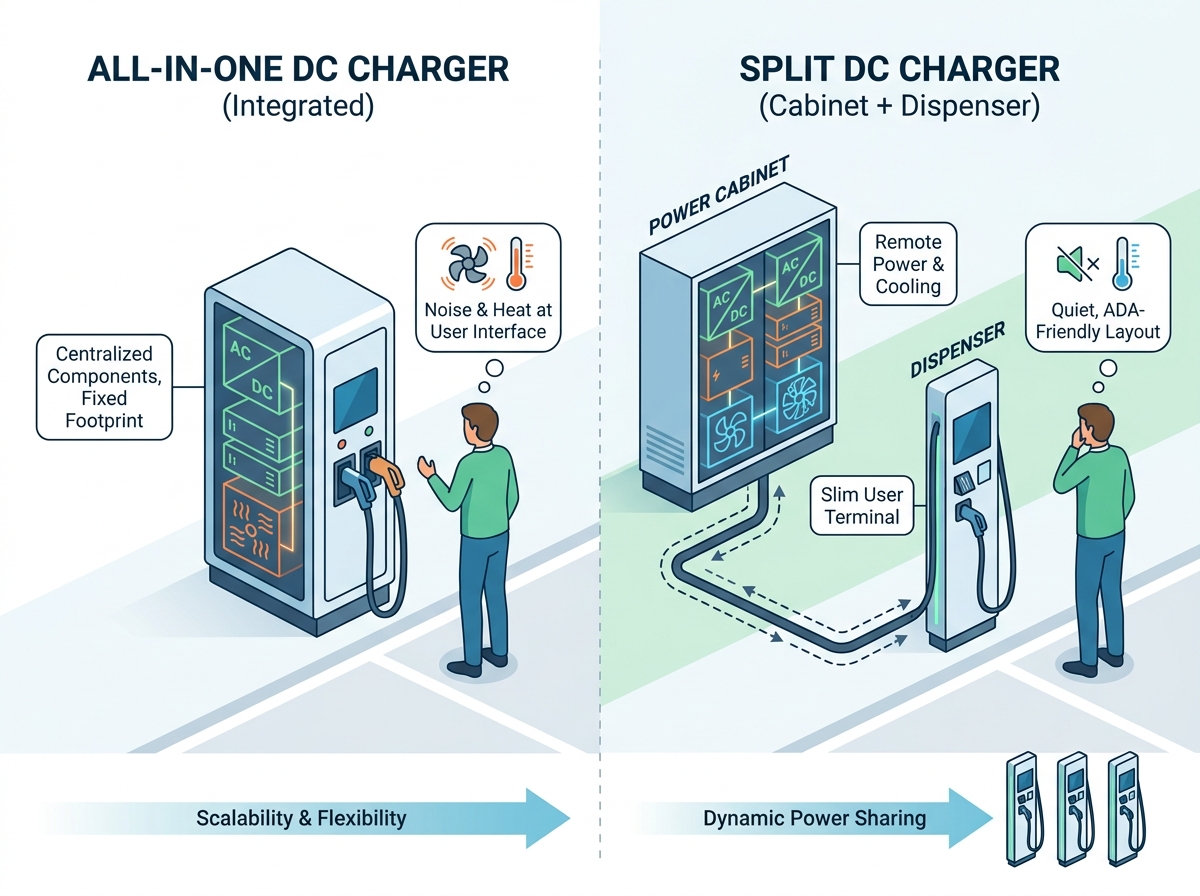
An integrated unit houses everything inside a single massive enclosure. It contains AC-to-DC rectifiers, power modules, and complex cooling systems. It also holds the dispensing cables, payment screens, and network routers. Industry professionals often call this an "all-in-one" approach. These units demand a larger, heavier physical footprint. Installers place them directly at the parking stall. They bolt the heavy chassis right to the pedestrian island.
This deployment reality simplifies single-unit procurement immensely. You only order one part number. You only schedule one crane drop. However, it centralizes heat generation right where the driver stands. It also brings intense acoustic noise directly to the user interface. High-power charging requires massive airflow to cool the rectifiers. When deploying an integrated DC fast charger, you trade physical space for logistical simplicity. Drivers will hear the fans spinning loudly during a summer charging session. You must accept this compromise for the sake of easy installation.
How a Split DC Charger Works (Cabinet + Dispenser)
A decentralized architecture operates on an entirely different philosophy. It separates the heavy components from the user interface. We call the heavy unit the power cabinet. We call the user interface the charge post or dispenser. This split design fundamentally changes site layouts.
The power cabinet houses the heavy grid connections and sensitive power modules. It contains the core cooling infrastructure for the rectifiers. Installers usually place these cabinets remotely. You might hide them behind a retail building. You can also place them near utility transformers at the edge of the property. The dispenser serves as a slim, lightweight terminal. It contains only the liquid-cooled charging cable, a touchscreen, and an RFID card reader. Utilizing a split DC charger keeps bulky components away from the pedestrian zone. It creates a cleaner look for your premium parking areas. DC cables run safely underground in conduits between the cabinet and the dispenser.
Core Evaluation Criteria: Evaluating Project Economics and Site Design
You must evaluate specific business and engineering trade-offs carefully before breaking ground. Each architecture impacts your site layout and your installation budget differently. Understanding these factors ensures long-term operational success.
Site Real Estate and ADA Compliance
Integrated units demand substantial space on the pedestrian island. This bulky footprint often complicates wheelchair clearance guidelines. Americans with Disabilities Act compliance remains non-negotiable for public charging sites. You must ensure wide, unobstructed pathways around the hardware. Heavy cabinets make this difficult on narrow curbs.
Split dispensers offer a massive advantage here. They feature a minimal footprint. This slim design preserves precious parking space. It also maintains clear visual sightlines across retail properties. You can easily fit these terminals onto tight pedestrian islands. They leave plenty of room for ADA-compliant ramps and turnaround spaces. Users navigate around them easily.
Installation Economics and Trenching
Installation costs vary wildly between the two designs. Integrated units require heavy-duty AC conduit routed directly to every single parking stall. You must pull thick copper wire to each individual unit. This process becomes expensive quickly. Utility interconnection becomes complex when managing multiple heavy AC drops across a large parking lot.
Conversely, a split system requires different planning. You must trench DC cables from the centralized cabinet out to the dispensers. Long DC cable runs can incur voltage drop. They also demand higher initial copper costs. However, centralizing your AC grid connections offers a major benefit. It significantly reduces utility interconnection complexity. You only need one massive AC drop to the central power cabinet. This simplifies the transformer upgrade process.
Scalability and Dynamic Power Allocation
All-in-one units usually have fixed maximum power outputs. For example, they might share a static 120kW or 180kW between two plugs. If one vehicle draws less power, the excess capacity often goes unused. It sits idle inside the machine. This wastes your available electrical infrastructure.
Split power cabinets operate differently. They utilize matrix switching to route power dynamically. The cabinet can shift unused power from a nearly full EV over to a newly plugged-in EV. This creates a highly efficient site.
Optimizes overall grid capacity utilization across the entire parking facility.
Reduces the number of wasted power modules sitting idle during vehicle taper phases.
Allows simultaneous charging of multiple vehicles at highly varied power speeds.
Simplifies future site expansion by adding cheap dispensers to existing power cabinets.
Architecture Feature Comparison
System Attribute
All-in-One Configuration
Decentralized Configuration
Pedestrian Footprint
Large, heavy, consumes island space
Minimal, slim, preserves walkways
Power Routing Flexibility
Fixed or basic dual-port splitting
Advanced matrix switching capabilities
Acoustic Emissions
High fan noise at the user terminal
Silent at terminal, loud at remote cabinet
Collision Vulnerability
High risk to expensive power modules
Low risk; power modules protected remotely
Maintenance, Uptime, and User Experience
Architecture heavily influences both operational expenditures and customer satisfaction. Hardware layout changes how technicians perform repairs. It also changes how drivers interact with your brand during their visit.
Noise and Heat Management
High-capacity AC to DC conversion generates significant heat. This thermal load requires powerful cooling fans. These fans create substantial acoustic noise. Split architectures keep this noise away from retail storefronts. They isolate the loud components near the utility transformer. Users enjoy a quiet, pleasant charging experience. Retailers avoid noise complaints from outdoor dining patrons. Conversely, integrated systems blast this hot air and noise directly onto the pedestrian walkway.
Serviceability Risks
Service procedures differ fundamentally between architectures. Keeping chargers online requires fast, safe maintenance workflows.
Identify the specific hardware fault through the remote network management dashboard.
Dispatch a certified technician to the physical charging site.
Isolate the malfunctioning power module inside the hardware enclosure.
Replace the individual module safely while minimizing customer disruption.
With integrated units, a power module failure can take the entire user-facing unit offline. The parking stall becomes dead space. Split systems offer better resilience. Modular power cabinets allow technicians to service components safely. They can swap power rectifiers without shutting down the entire site. They also perform this work away from the parking stalls. This keeps traffic flowing smoothly around the active dispensers.
Vandalism and Damage
Vehicle strikes happen frequently in busy parking lots. Drivers accidentally back into equipment constantly. If a driver strikes an integrated charger, they destroy the most expensive components. The power modules take the direct impact. This leads to massive replacement costs. If a vehicle strikes a split dispenser, the damage remains limited. Only the low-cost terminal needs replacing. The expensive power electronics sit safely away from traffic zones.
Scenario Matching: Which Architecture Fits Your Strategy?
We provide a strict decision matrix based on commercial use cases. You must align the hardware with your core business model.
Scenario A: Convenience Stores and QSRs (1-2 Stalls)
We generally recommend integrated units for these locations. Quick Service Restaurants prefer lower upfront engineering complexity. Installers find it easier to drop these self-contained units into existing tight parking lots. They avoid running extensive underground DC conduits across a busy property. Small sites rarely trigger massive utility demand charges. A simple, standalone hardware approach makes perfect sense here.
Scenario B: Large-Scale Public Charging Hubs (4+ Stalls)
We strongly recommend split architectures for large hubs. High-density locations require dynamic power sharing. This feature manages grid demand charges effectively. It optimizes the parking layout for maximum vehicle throughput. It also allows operators to add dispensers later. You can scale up your charging footprint easily. You avoid upgrading the main grid transformer immediately by utilizing matrix switching.
Scenario C: Fleet Depots (Overnight or Hub Turnaround)
Commercial fleet depots should choose split architectures with overhead or slim dispensers. Depots must maximize vehicle maneuverability above all else. Heavy-duty trucks require wide turning radii. Bulky hardware introduces serious collision risks. Slim dispensers protect sensitive power electronics from heavy-duty vehicle traffic. They keep the driving aisles clear. They also integrate nicely into overhead gantries for electric delivery vans.
Procurement Risks and Implementation Blind Spots
You must understand compliance and vendor-evaluation realities. This ensures successful project implementation and prevents budget overruns.
Distance Limitations
Split systems face strict engineering constraints. DC cable runs cannot extend indefinitely across a property. If distances exceed vendor specifications, you face unacceptable voltage drop. This severely impacts vehicle charging speeds. It causes massive energy loss. It may also require costly liquid-cooled cabling to mitigate excess heat. Always verify maximum cable lengths with your hardware manufacturer before finalizing trenching plans.
Interoperability and Vendor Lock-in
Hardware ecosystems demand careful vendor selection. Dispensers and cabinets from the same manufacturer pair seamlessly. They communicate using proprietary internal protocols. However, mixing components from different vendors remains highly complex. Experts do not recommend forcing interoperability for standard deployments. It creates severe firmware integration headaches. Stick to a unified hardware ecosystem for long-term reliability.
Lead Times
Supply chain realities dictate your project schedules. High-capacity centralized power cabinets often face longer manufacturing delays. They require complex, specialized electrical components. Standard integrated units usually ship much faster. You must factor these lead times into your construction schedule early. Delays in central cabinet delivery will stall your entire charging hub launch.
Conclusion
The choice between an integrated or decentralized system is not about which technology is inherently superior. It is about which setup aligns perfectly with your site layout. You must balance utility constraints against your long-term growth timeline.
Before moving forward, you should take several concrete steps. First, conduct a comprehensive site audit to measure available pedestrian space. Second, map out exact utility transformer distances to calculate underground cable runs. Third, request thorough financial lifecycle modeling. You must factor in expected maintenance budgets and potential stall expansions. Finally, finalize these expansion plans completely before releasing your hardware RFPs to vendors.
FAQ
Q: What is the maximum distance a power cabinet can be from a split DC dispenser?
A: Manufacturers typically cap DC cable lengths between 30 to 100 meters. Exceeding these limits causes severe voltage drop and energy loss. High-power systems pushing 350kW often require shorter runs or specialized liquid-cooled cables to maintain efficiency. Always consult specific vendor engineering guidelines before trenching.
Q: Are split DC chargers more expensive to install than all-in-one units?
A: They carry a higher baseline cost for small deployments of one or two ports due to the expensive central cabinet. However, the economics flip at scale. For sites with four or more dispensers, the per-port installation and hardware costs drop significantly, making split systems cheaper overall.
Q: Do both architectures qualify for NEVI funding?
A: Yes, both hardware architectures can qualify for National Electric Vehicle Infrastructure (NEVI) funds. They must successfully deliver 150kW of simultaneous power to each mandated port. They must also meet the strict 97% uptime operational requirement enforced by the federal program.
Q: Can an integrated DC fast charger offer dynamic power sharing?
A: Some modern dual-port units offer basic power splitting between their two native cables. However, they completely lack the site-wide, multi-dispenser dynamic routing capabilities of a centralized power cabinet. They cannot share power fluidly across a massive charging hub like a matrix system can.