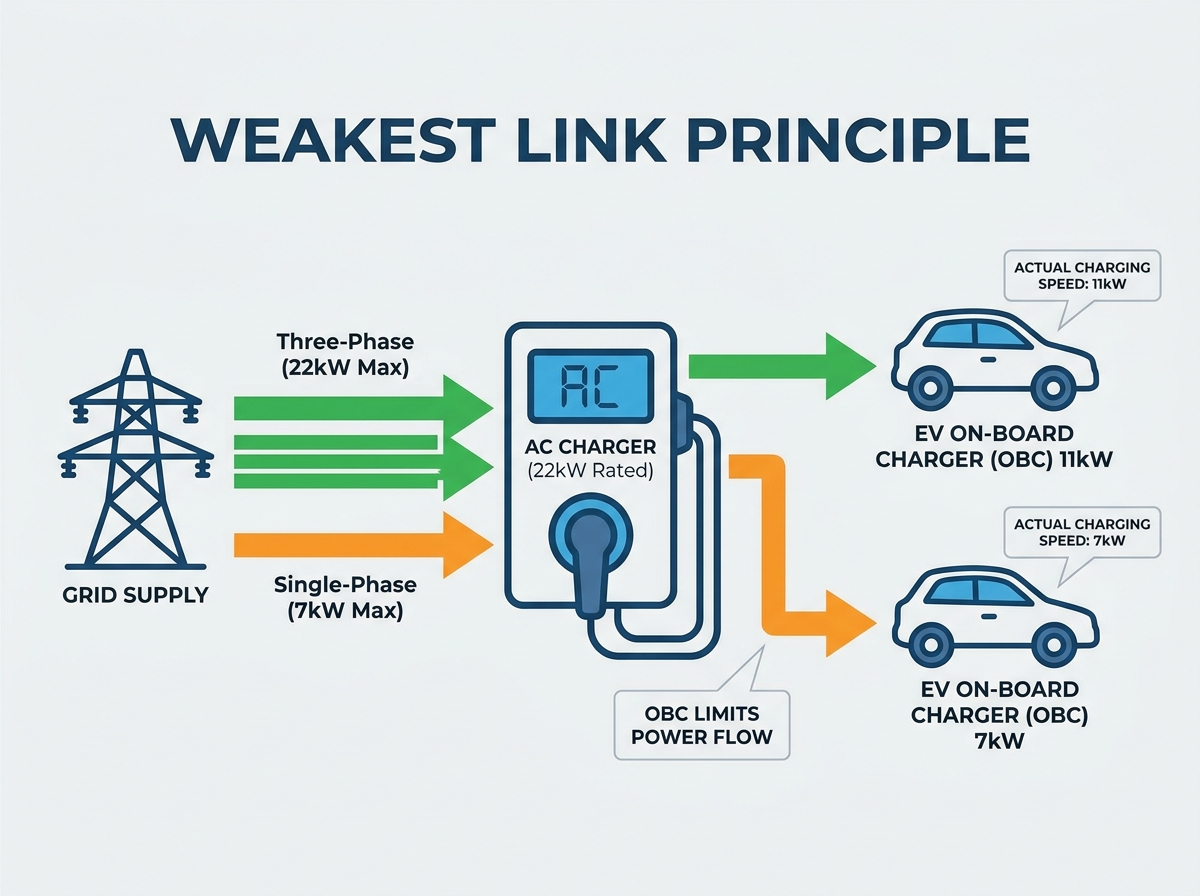
You bought a top-tier electric vehicle and installed a premium high-speed charging station. You expect maximum performance immediately. Yet, when you plug it in, the dashboard stubbornly displays a charging speed of just 7kW or 11kW instead of the promised 22kW. This expectation versus reality gap causes immense frustration for many new EV owners. Ultimately, AC power delivery follows a strict "weakest link" rule. It is governed by your charging station, your building's electrical grid, and the car's internal hardware. We will break down exactly why this bottleneck happens and how you can avoid common compatibility traps. You will learn how to evaluate your true capacity and avoid overpaying for unnecessary hardware. By the end, you will know exactly how to specify your residential or commercial infrastructure correctly.
Key Takeaways
The Vehicle Dictates the Limit: Your EV’s internal On-Board Charger (OBC) acts as a hard cap on AC charging speeds, regardless of the wall charger’s maximum output.
Phase Power Matters: Delivering 22kW requires a three-phase electrical supply. Standard single-phase residential grids are physically limited to 7kW.
Strategic Purchasing: For over 90% of residential users, a high-quality 7kW home EV charger offers the most cost-effective solution for overnight charging without requiring expensive grid upgrades.
The Hardware Bottleneck: Understanding the On-Board Charger (OBC)
We must first understand the fundamental difference between AC and DC charging. Wallboxes deliver alternating current (AC) power. However, EV batteries exclusively store direct current (DC) power. Therefore, an essential conversion step must happen inside the vehicle. Your car relies on an internal component called the On-Board Charger (OBC). It acts as a built-in inverter. It transforms incoming AC energy into useable DC energy.
This OBC represents the ultimate hardware bottleneck. It enforces a strict "weakest link" principle across the entire system. Imagine your car has a maximum OBC capacity of 11kW. This specific rating remains highly common across many modern EVs. If you plug it into a massive 22kW station, you will only ever receive 11kW. The car simply refuses extra power. You cannot force more electricity into the battery.
Why do automakers restrict this capacity? They balance several strict engineering constraints. A larger OBC adds significant weight to the chassis. Heavy components reduce overall driving range. High-capacity inverters also increase manufacturing expenses substantially. Furthermore, they generate substantial heat during operation. Engineers must integrate complex liquid cooling systems. Therefore, manufacturers size the OBC to meet average daily driving needs. They rarely optimize it solely for maximum possible speed.
This hardware cap directly impacts your total EV charging time. Buying an oversized wallbox rarely yields faster results for daily commuters. You must calculate your speed based on the car's explicit limit. We outline a quick framework below showing how actual speeds play out in real-world scenarios.
Table: Hardware Bottlenecks and Actual Charging Speeds
Wallbox Maximum Output
Vehicle OBC Limit
Actual Delivered Speed
Limiting Factor
7.4kW
11kW
7.4kW
Wallbox Capacity
22kW
11kW
11kW
Vehicle OBC Limit
22kW
7.4kW
7.4kW
Vehicle OBC Limit
22kW
22kW
22kW
None (Fully Optimized)
Grid Infrastructure Realities: Single-Phase vs. Three-Phase Power
We must evaluate the electrical supply side next. Let us assume your car can accept high speeds flawlessly. Your building's electrical infrastructure becomes the next critical limiting factor. Most residential homes operate exclusively on single-phase power. A standard single-phase connection carries one alternating current wave. This physical constraint dictates maximum throughput.
The maximum safe sustained draw limits charging to approximately 7kW or 7.4kW on these residential setups. Residential electrical panels usually max out at 100 amps or 200 amps entirely. Dedicating 32 amps continuously to a vehicle consumes a massive portion of available capacity. Household appliances compete heavily for this remaining bandwidth. Therefore, pushing beyond 7kW on a single phase risks tripping your main breaker.
Reaching 11kW or 22kW explicitly requires a three-phase power supply. This setup uses three separate live wires. They deliver power in overlapping waves. Commercial properties typically feature three-phase connections by default. They support heavy machinery and large HVAC systems. However, upgrading a standard residential home is often prohibitively expensive. Sometimes, it remains geographically impossible depending on local grid layouts. You cannot simply install a faster unit and expect magic results. The grid must possess the physical wires to supply it.
The Compatibility Trap: When Cables and Phases Don't Align
Many buyers fall into a highly misunderstood technical trap during installation. They purchase an 11kW wallbox hoping for future-proofing. Then, they plug in an older single-phase EV. Suddenly, they only see speeds of 3.6kW. They naturally assume the equipment is broken. Why does this dramatic drop-off happen?
An 11kW station relies entirely on three-phase power. It splits the total electrical output evenly across three distinct live wires. Each individual wire carries exactly 3.6kW. If you multiply 3.6 by three, you get roughly 11kW. If your car features a single-phase 7kW OBC, it connects to just one live wire. The vehicle can only pull power from that specific single phase. Consequently, it receives a strict maximum of 3.6kW. It physically cannot combine the other two phases.
This exact scenario makes 11kW units risky for mixed-use environments. Public destinations solve this compatibility headache elegantly. They deploy the 22kW AC charger as a universal standard. A 22kW unit delivers a robust 7.4kW across each of its three phases. Single-phase cars grab one phase. They successfully achieve their maximum 7kW limit without penalties. Three-phase cars utilize all three lines. They reach 11kW or 22kW seamlessly. This ensures everyone gets the fastest possible charge based on their unique OBC.
Decision Framework: Specifying the Right Charger for Your Needs
Choosing the correct equipment requires a clear evaluation matrix. You must align your vehicle capabilities against your property constraints. We categorized the main solutions below to streamline your purchasing decisions. Avoid buying more capacity than you can realistically utilize.
1. When to Buy a 7kW Home EV Charger
This category remains the absolute best choice for over 90% of residential setups. It perfectly aligns with standard single-phase home wiring. You avoid complex utility requests. Furthermore, a 7kW home EV charger fully replenishes most EV batteries overnight. A typical session takes 8 to 10 hours while you sleep. Faster speeds prove entirely unnecessary for daily commuting habits. It offers the smartest balance of performance and practicality.
2. When to Spec an 11kW Charger
You should consider this option strictly if you already possess three-phase power at home or work. It serves as an ideal match if your primary EV features an 11kW OBC. It maximizes charging efficiency for compatible modern vehicles. However, a major caveat exists. Avoid this setup if multiple single-phase EVs share the driveway. You risk triggering the frustrating 3.6kW drop-off trap discussed earlier.
3. When to Invest in a 22kW AC Charger
These heavy-duty units serve commercial applications perfectly. They dominate public destination charging networks and corporate fleets. Some high-end homes boast three-phase power and dual-22kW capable vehicles. For instance, an upgraded Porsche Taycan or an older Renault Zoe can utilize this immense flow. While it future-proofs commercial infrastructure beautifully, it offers remarkably low return on investment for standard residential users.
Implementation Costs and Compliance Considerations
Chasing maximum speeds introduces several hidden implementation costs. You must conduct a thorough cost versus outcome assessment before committing. High-speed setups demand robust infrastructure. Upgrading a property rarely stops at the wallbox purchase alone. You must account for systemic electrical modifications.
First, evaluate potential grid upgrade fees. Requesting a three-phase connection from your local Distribution Network Operator (DNO) takes time. Local utilities often charge thousands of dollars for this extensive groundwork. They must trench new cables from the street to your meter box. For most homeowners, this single expense nullifies any marginal benefit gained by faster charging.
Second, factor in explicit hardware premiums. The price difference between standard units and high-capacity models remains noticeable. You also face stricter cabling requirements. Installers must use thicker, more expensive copper wires. They must install upgraded circuit breakers to handle the intensified thermal loads safely. Installation labor costs scale upward accordingly.
Finally, you must implement dynamic load balancing. High-capacity units pull massive amounts of current. You need intelligent load management systems. These systems prevent high-speed chargers from tripping main commercial or residential fuses during peak usage times. The software automatically throttles vehicle charging if the building's HVAC system or ovens draw heavy power simultaneously. This necessary compliance technology adds another layer of complexity to the final bill.
Conclusion
An EV charger can never force power into a car faster than its On-Board Charger allows. Similarly, it cannot deliver more energy than your local grid physically supplies. The entire ecosystem adheres to strict engineering limits. Recognizing these bottlenecks saves buyers significant time and capital.
We recommend several immediate next steps before finalizing a hardware purchase. First, check your specific vehicle's AC charging limit in the owner's manual. Second, ask an electrician to verify your property's electrical phase. Third, resist the urge to over-spec your equipment based on assumptions. We firmly steer most residential buyers toward a reliable 7kW setup. It consistently provides optimal overnight performance without triggering massive infrastructure upgrade fees.
FAQ
Q: Will plugging into a 22kW AC charger damage my 7kW car?
A: No. The vehicle's OBC communicates with the charger and safely limits the power intake to 7kW. The station only supplies the exact amount of energy requested by the vehicle.
Q: Can a software update unlock 22kW charging on my 11kW EV?
A: No. The OBC is a physical hardware component installed at the factory. Its maximum capacity cannot be increased via over-the-air (OTA) software updates. You would need a complete hardware replacement.
Q: Why does my EV charge at 150kW at highway stations, but only 11kW at home?
A: Highway chargers are DC fast chargers. They bypass the vehicle's internal OBC and feed direct current straight into the battery. Home chargers use AC power, which remains strictly limited by the OBC's conversion capacity.
Q: Do I need a special cable for a 22kW AC charger?
A: Yes. To achieve 22kW, you must use a three-phase, 32-amp rated Type 2 charging cable. A single-phase or 16-amp cable will artificially bottleneck the speed, preventing you from reaching maximum throughput.